Amazon.com Widgets

Monday, April 28, 2008

Florida Continues its Anti-Citizen, Anti-Democracy, Anti-Constitutional Immoralities

Florida Citizens Continue to Acquiesce to Their Republican Rulers

April 28, 2008

Election Day in Florida May Look Familiar

By DAMIEN CAVE MIAMI — The League of Women Voters in Florida and its 27 local groups have helped thousands of residents register to vote over the years.

But just over a week ago, the organization’s leaders said they would have to stop their current drive because the state’s top election official planned to enforce strict deadlines and fines of up to $1,000 for groups that lose voter registration forms or turn them in late.

“We’re an all-volunteer organization,” said Dianne Wheatley-Giliotti, president of the League of Women Voters in Florida, which plans to sue. “It’s a matter of being able to protect the leagues from liability.”

Eight years after the debacle of “hanging chads,” Florida once again seems to be courting electoral trouble. A handful of laws have been passed since the 2000 presidential recount, with state officials saying they bring order to a chaotic system.

“Some say we err on the side of caution,” said Joe Pickens, a Republican from Palatka who served on the Florida House’s Ethics and Elections Committee in 2005 and 2006. “I would say that’s the place we should be.”

But Election Day may end up looking oddly familiar. According to independent elections experts at Pew’s Electionline.org and other organizations, it is now harder to vote here than in nearly every other state in the nation. Some critics predict that tens of thousands of potential voters will be kept off the rolls — many of them poor, black or Hispanic.

In many ways, the battle over the laws reflects the larger national debate over how to overhaul the election system after the 2000 recount. Congress tried to institute a uniform guide for voter registration, but the compromise legislation left many details to the states, and partisanship arose in the void. Republicans typically demanded high standards of accuracy to eliminate voter fraud, while Democrats focused on making voting as easy as possible.

Many states decided that disputes would be worked out case by case, without written rules. But more ambitious states, including Florida, responded with new policies or laws. By 2006, for example, at least 11 states had “no match, no vote” provisions, rejecting potential voters whose Social Security numbers or driver’s license numbers did not match state databases.

Civil rights groups challenged much of the new legislation in court, and they often won. But in Florida, many of the cases remain unresolved.

Three laws in particular are at issue, including a “no match, no vote” measure; the provision managing voter registration drives conducted by third parties, like the League of Women Voters; and a law that would keep a voter from correcting mistakes or omissions on a registration form in the final month before an election and would bar that person from having his or her vote counted.

Two recent federal rulings have gone in the state’s favor.

On March 25, a Federal District Court in Miami rejected a challenge to the provision on corrections and omissions.

An oversight can be as simple as failing to check what many Florida residents call the “crazy box.” It asks people to affirm: “I have not been adjudicated mentally incapacitated with respect to voting or, if I have, my competency has been restored.”

So far, about 3 percent of voter registrations collected by the Florida chapter of Acorn, a national organizing group, have lacked the required checkmarks.

In the second decision, on April 3, the United States Court of Appeals for the 11th Circuit, in Atlanta, sent a case challenging the “no match, no vote” law back to a Federal District Court, reversing an earlier injunction without ruling whether the law was unconstitutional.

Other states, meanwhile, have been moving in the opposite direction. Now, 33 states allow voters to amend forms after their registration deadlines. In 2006, a judge in Washington State struck down a “no match, no vote” law, and at least six other states have abandoned similar provisions.

Election lawyers say Florida’s Republican-controlled government has introduced more restrictions on the voting process than other states since 2000 and has fought harder to keep them.

Critics say state officials are subtly trying to block new voters, many of whom tend to vote for Democrats, from participating.

“It’s really about politicians trying to game the system,” said Michael Slater, deputy director of Project Vote, a voting rights organization based in Arkansas. “They’ve done that by adding all these bureaucratic obstacles to voting, and then when people can’t jump over them, they blame the voter.”

Gov. Charlie Crist of Florida, a Republican, sidestepped specific questions about the state’s approach.

“We want to have as many people vote as want to vote that are legally registered to vote,” Mr. Crist said. He also offered to “do some campaigning to encourage people to register to vote.”

Some volunteers actually registering voters are not pleased. The Florida statute governing such groups is somewhat unusual. Besides Florida, only New Mexico assesses fines on them. The law is also a second try.

The first effort, in 2006, called for fines of up to $5,000 per form, but it was struck down in federal court after the League of Women Voters filed suit.

The state appealed but in the meantime passed an amended law, cutting the fines but keeping some original elements in place. A “standstill agreement” between the state and the plaintiffs kept the new law from being enforced, until Secretary of State Kurt S. Browning gave notice of his plans in court documents in late March. In a statement, his office said it was obligated to enforce the new law.

His office said it had not started assessing penalties. It has also acknowledged that the law is vague on whether the cap of $1,000 would apply to an entire organization, a chapter or individual volunteers.

Ms. Wheatley-Giliotti of the League of Women Voters said her group’s roughly 3,000 members could not risk paying the fines. The organization stopped helping voters register for the first time in 2006, before a federal judge struck down the original law that August.

Now, she said, the group must stop again because some local leagues have a budget of only $1,000.

Ms. Wheatley-Giliotti said: “I just believe it’s making it much more difficult for many sectors of the population to register. It’s groups like the League of Women Voters that take extra steps so that seniors, the poor, the underrepresented have an opportunity to register to vote conveniently.”

Christine Jordan Sexton contributed reporting from Tallahassee, Fla.

Online NYT article here.

Labels: , , , ,

Tuesday, February 12, 2008

Cult of Personality + American Sexism + Media Bias + Groupthink = ???

Racism, misogyny and character assassination are all ways of distracting voters from the issues.

Hate Springs Eternal

By PAUL KRUGMAN
OP-ED COLUMNIST
February 11, 2008

In 1956 Adlai Stevenson, running against Dwight Eisenhower, tried to make the political style of his opponent’s vice president, a man by the name of Richard Nixon, an issue. The nation, he warned, was in danger of becoming “a land of slander and scare; the land of sly innuendo, the poison pen, the anonymous phone call and hustling, pushing, shoving; the land of smash and grab and anything to win. This is Nixonland.”

Krugman: Even the Democratic Party seems to be turning into Nixonland: the land of slander and scare, the politics of hatred.

Most of the venom I see is coming from supporters of Mr. Obama, who want their hero or nobody. I’m not the first to point out that the Obama campaign seems dangerously close to becoming a cult of personality. We’ve already had that from the Bush administration.

The quote comes from “Nixonland,” a soon-to-be-published political history of the years from 1964 to 1972 written by Rick Perlstein, the author of “Before the Storm.” As Mr. Perlstein shows, Stevenson warned in vain: during those years America did indeed become the land of slander and scare, of the politics of hatred.

And it still is. In fact, these days even the Democratic Party seems to be turning into Nixonland.

The bitterness of the fight for the Democratic nomination is, on the face of it, bizarre. Both candidates still standing are smart and appealing. Both have progressive agendas (although I believe that Hillary Clinton is more serious about achieving universal health care, and that Barack Obama has staked out positions that will undermine his own efforts). Both have broad support among the party’s grass roots and are favorably viewed by Democratic voters.

Supporters of each candidate should have no trouble rallying behind the other if he or she gets the nod.

Why, then, is there so much venom out there?

I won’t try for fake evenhandedness here: most of the venom I see is coming from supporters of Mr. Obama, who want their hero or nobody. I’m not the first to point out that the Obama campaign seems dangerously close to becoming a cult of personality. We’ve already had that from the Bush administration — remember Operation Flight Suit? We really don’t want to go there again.

What’s particularly saddening is the way many Obama supporters seem happy with the application of “Clinton rules” — the term a number of observers use for the way pundits and some news organizations treat any action or statement by the Clintons, no matter how innocuous, as proof of evil intent.

The prime example of Clinton rules in the 1990s was the way the press covered Whitewater. A small, failed land deal became the basis of a multiyear, multimillion-dollar investigation, which never found any evidence of wrongdoing on the Clintons’ part, yet the “scandal” became a symbol of the Clinton administration’s alleged corruption.

During the current campaign, Mrs. Clinton’s entirely reasonable remark that it took L.B.J.’s political courage and skills to bring Martin Luther King Jr.’s dream to fruition was cast as some kind of outrageous denigration of Dr. King.

And the latest prominent example came when David Shuster of MSNBC, after pointing out that Chelsea Clinton was working for her mother’s campaign — as adult children of presidential aspirants often do — asked, “doesn’t it seem like Chelsea’s sort of being pimped out in some weird sort of way?” Mr. Shuster has been suspended, but as the Clinton campaign rightly points out, his remark was part of a broader pattern at the network.

I call it Clinton rules, but it’s a pattern that goes well beyond the Clintons. For example, Al Gore was subjected to Clinton rules during the 2000 campaign: anything he said, and some things he didn’t say (no, he never claimed to have invented the Internet), was held up as proof of his alleged character flaws.

For now, Clinton rules are working in Mr. Obama’s favor. But his supporters should not take comfort in that fact.

For one thing, Mrs. Clinton may yet be the nominee — and if Obama supporters care about anything beyond hero worship, they should want to see her win in November.

For another, if history is any guide, if Mr. Obama wins the nomination, he will quickly find himself being subjected to Clinton rules. Democrats always do.

But most of all, progressives should realize that Nixonland is not the country we want to be. Racism, misogyny and character assassination are all ways of distracting voters from the issues, and people who care about the issues have a shared interest in making the politics of hatred unacceptable.

One of the most hopeful moments of this presidential campaign came last month, when a number of Jewish leaders signed a letter condemning the smear campaign claiming that Mr. Obama was a secret Muslim. It’s a good guess that some of those leaders would prefer that Mr. Obama not become president; nonetheless, they understood that there are principles that matter more than short-term political advantage.

I’d like to see more moments like that, perhaps starting with strong assurances from both Democratic candidates that they respect their opponents and would support them in the general election.

Krugman could've also mentioned the phenomenon of GroupThink (Irving Janis), which also infected the Kennedy administration, and certainly every republican one since then. And don't forget the Republicans are still pining for the Cult of Personality and pure fantasy surrounding Ronald Reagan.

Krugman's online column here.


............................................................

Donate to Hillary Clinton Online

(and any way you can). Fast. Easy. Secure.
............................................................


Technorati Tags:
, , , , , , ,


Labels: , , , , , , , , ,

Friday, February 08, 2008

Krugman: Next President Must Have Two Key Attributes for Economic Success

It's the Economy ... and the Incompetency ... and jobs, and healthcare, and interest rates, and housing, and the war ...


From Krugman:

.....some highly respected economists are issuing dire warnings. There has been a lot of buzz about a new paper by Carmen Reinhart and Kenneth Rogoff that compares the United States in recent years to other advanced countries that have experienced financial crises. They find that the U.S. profile resembles that of the “big five crises,” a list that includes, for example, Sweden’s 1991 crisis, which caused the unemployment rate to soar from 2 percent to 9 percent over a two-year period.

...by January the White House will have a new occupant. If the slump is still going on, which is likely, this will offer a chance to consider other, more effective measures.

We need a new 'put america back to work' public-private initiative

In particular, now would be a good time to think about the possibility of going beyond tax cuts and rebate checks, and stimulating the economy with some much-needed public investment — say, in repairing the country’s crumbling infrastructure.

The usual rap against public spending as a form of economic stimulus is that it takes too long to get going — that by the time the money starts flowing, the recession is already over. But if this turns out to be a prolonged slump, which seems likely, that won’t be a problem.

But we won’t get any innovative action to help the economy unless the next president has a couple of key attributes.

First, he or she has to be free of the ideological blinders that make the current administration and its allies fiercely oppose the idea that the government can do anything positive aside from cutting taxes.

Second, he or she has to be knowledgeable about and interested in economic policy. Presidents don’t have to be their own chief economists, but they do need to know enough to take the right advice.

Will we have that kind of president? Stay tuned.


Here's what I think we need with a new president starting on day one:

a new 'put america back to work' WPA type public-private initiative with a focus on including:

• repairing/updating/improving all aspects of the infrastructure; include job training and career-shift education which puts americans to work in good paying jobs (with benefits) created from public-private partnerships;

• a commitment to oil/gas-free energy independence/green technology/energy innovations (mostly avoid biofuels because it does more harm than good in the long run; see recent research/reports);

• a focus on fast-tracking science and technology education for public schools, community colleges, universities (includes job-training/ed for adults); create public private partnerships and feeder schools in urban, suburban, rural hubs -- those things focus on both items above.

Those are just the off-the-top-of-my-head ideas about what the current admin has failed to do in all its glorious incompetence and abysmal domestic failures and what the next president must be held accountable to do, in addition to healthcare coverages, repairing the damage of the Iraq War, fixing the failing Afghanistan War failures, etc.

and I think it's compatible w/ what Krugman is discussing in today's column.


Krugman's entire column: http://www.nytimes.com/2008/02/08/opinion/08krugman.html


............................................................

Donate to Hillary Clinton Online

(and any way you can). Fast. Easy. Secure.
............................................................


Technorati Tags:
, , ,


Labels: , , , , , , ,

It's not because she's a woman ...

"Me, I’m voting for Hillary not because she’s a woman—but because I am."


Two insightful must-reads: Judith Warner's blog entry "Like a Fish Needs a Donut" in the NYT and (referenced in Warner's blog entry) Robin Morgan's recent "Goodbye to All That (#2)" essay at the Women's Media Center. As Morgan concludes:

"Me, I’m voting for Hillary not because she’s a woman—but because I am."


Donate to Hillary Clinton Online

(and any way you can). Fast. Easy. Secure.


............................................................


Technorati Tags:
, ,


Labels: , , , , , , , , ,

Monday, February 04, 2008

Krugman: Only Clinton Achieves Universal Healthcare, Obama Won't

Universal Health Care: Only One Candidate's Plan Achieves It

(and it sure ain't one of the Republicans)


The New York Times's Economist and Columnist, Paul Krugman's analysis and bottom line: If Clinton gets the Democratic nomination, there is some chance that we’ll get universal health care in the next administration. If Obama gets the nomination, it just won’t happen.


...the difference between the plans could well be the difference between achieving universal health coverage — a key progressive goal — and falling far short.


Obama's plan costs more than 80 percent as much as Clinton's and covers only about half of those 47 million currently uninsured


...the Obama-type plan would cost $4,400 per newly insured person, the Clinton-type plan only $2,700.


That doesn’t look like a trivial difference ... One plan achieves more or less universal coverage; the other, although [Obama's plan] costs more than 80 percent as much, covers only about half of those currently uninsured.


Krugman's complete explanation of his analysis is here: http://www.nytimes.com/2008/02/04/opinion/04krugman.html

Labels: , , , , , , , , ,

Thursday, January 24, 2008

NYTimes 08 Primary Endorsements: Clinton, McCain

Times Endorses Clinton, McCain in Primaries


Clinton is overall favorite

The editorial board touts Senator Clinton's "powerful intellect" and her genuine, needed ability to 'hit the ground running on day one' to solve the complex problems cause by the ineptness of George Bush (and the republicans).

Unlike the in-depth analysis of Clinton's strengths, what's interesting about the paper's endorsement of McCain is that more space is spent dismantling the other Republican candidates than on McCain, who wins their endorsement in the Republican primary mainly because he "promises to end the George Bush style of governing from and on behalf of a small, angry fringe. With a record of working across the aisle to develop sound bipartisan legislation, he would offer a choice to a broader range of Americans than the rest of the Republican field."

We have strong disagreements with all the Republicans running for president. The leading candidates have no plan for getting American troops out of Iraq. They are too wedded to discredited economic theories and unwilling even now to break with the legacy of President Bush. We disagree with them strongly on what makes a good Supreme Court justice.

As to why they're not endorsing the city's 'favorite son' (Giuliani):

The real Mr. Giuliani, whom many New Yorkers came to know and mistrust, is a narrow, obsessively secretive, vindictive man who saw no need to limit police power. Racial polarization was as much a legacy of his tenure as the rebirth of Times Square.

Mr. Giuliani’s arrogance and bad judgment are breathtaking. When he claims fiscal prudence, we remember how he ran through surpluses without a thought to the inevitable downturn and bequeathed huge deficits to his successor. He fired Police Commissioner William Bratton, the architect of the drop in crime, because he couldn’t share the limelight. He later gave the job to Bernard Kerik, who has now been indicted on fraud and corruption charges.

The Rudolph Giuliani of 2008 first shamelessly turned the horror of 9/11 into a lucrative business, with a secret client list, then exploited his city’s and the country’s nightmare to promote his presidential campaign.


Here is the entire Clinton endorsement and the reasoning behind it:

January 25, 2008
NYT EDITORIAL

Primary Choices: Hillary Clinton

This generally is the stage of a campaign when Democrats have to work hard to get excited about whichever candidate seems most likely to outlast an uninspiring pack. That is not remotely the case this year.

The early primaries produced two powerful main contenders: Hillary Clinton, the brilliant if at times harsh-sounding senator from New York; and Barack Obama, the incandescent if still undefined senator from Illinois. The remaining long shot, John Edwards, has enlivened the race with his own brand of raw populism.

As Democrats look ahead to the primaries in the biggest states on Feb. 5, The Times’s editorial board strongly recommends that they select Hillary Clinton as their nominee for the 2008 presidential election.

We have enjoyed hearing Mr. Edwards’s fiery oratory, but we cannot support his candidacy. The former senator from North Carolina has repudiated so many of his earlier positions, so many of his Senate votes, that we’re not sure where he stands. We certainly don’t buy the notion that he can hold back the tide of globalization.

By choosing Mrs. Clinton, we are not denying Mr. Obama’s appeal or his gifts. The idea of the first African-American nominee of a major party also is exhilarating, and so is the prospect of the first woman nominee. “Firstness” is not a reason to choose. The times that false choice has been raised, more often by Mrs. Clinton, have tarnished the campaign.

Mr. Obama and Mrs. Clinton would both help restore America’s global image, to which President Bush has done so much grievous harm. They are committed to changing America’s role in the world, not just its image. On the major issues, there is no real gulf separating the two. They promise an end to the war in Iraq, more equitable taxation, more effective government spending, more concern for social issues, a restoration of civil liberties and an end to the politics of division of George W. Bush and Karl Rove.

Mr. Obama has built an exciting campaign around the notion of change, but holds no monopoly on ideas that would repair the governing of America. Mrs. Clinton sometimes overstates the importance of résumé. Hearing her talk about the presidency, her policies and answers for America’s big problems, we are hugely impressed by the depth of her knowledge, by the force of her intellect and by the breadth of, yes, her experience.

It is unfair, especially after seven years of Mr. Bush’s inept leadership, but any Democrat will face tougher questioning about his or her fitness to be commander in chief. Mrs. Clinton has more than cleared that bar, using her years in the Senate well to immerse herself in national security issues, and has won the respect of world leaders and many in the American military. She would be a strong commander in chief.

Domestically, Mrs. Clinton has tackled complex policy issues, sometimes failing. She has shown a willingness to learn and change. Her current proposals on health insurance reflect a clear shift from her first, famously disastrous foray into the issue. She has learned that powerful interests cannot simply be left out of the meetings. She understands that all Americans must be covered — but must be allowed to choose their coverage, including keeping their current plans. Mr. Obama may also be capable of tackling such issues, but we have not yet seen it. Voters have to judge candidates not just on the promise they hold, but also on the here and now.

The sense of possibility, of a generational shift, rouses Mr. Obama’s audiences and not just through rhetorical flourishes. He shows voters that he understands how much they hunger for a break with the Bush years, for leadership and vision and true bipartisanship. We hunger for that, too. But we need more specifics to go with his amorphous promise of a new governing majority, a clearer sense of how he would govern.

The potential upside of a great Obama presidency is enticing, but this country faces huge problems, and will no doubt be facing more that we can’t foresee. The next president needs to start immediately on challenges that will require concrete solutions, resolve, and the ability to make government work. Mrs. Clinton is more qualified, right now, to be president.

We opposed President Bush’s decision to invade Iraq and we disagree with Mrs. Clinton’s vote for the resolution on the use of force. That’s not the issue now; it is how the war will be ended. Mrs. Clinton seems not only more aware than Mr. Obama of the consequences of withdrawal, but is already thinking through the diplomatic and military steps that will be required to contain Iraq’s chaos after American troops leave.

On domestic policy, both candidates would turn the government onto roughly the same course — shifting resources to help low-income and middle-class Americans, and broadening health coverage dramatically. Mrs. Clinton also has good ideas about fixing the dysfunction in Mr. Bush’s No Child Left Behind education program.

Mr. Obama talks more about the damage Mr. Bush has done to civil liberties, the rule of law and the balance of powers. Mrs. Clinton is equally dedicated to those issues, and more prepared for the Herculean task of figuring out exactly where, how and how often the government’s powers have been misused — and what must now be done to set things right.

As strongly as we back her candidacy, we urge Mrs. Clinton to take the lead in changing the tone of the campaign. It is not good for the country, the Democratic Party or for Mrs. Clinton, who is often tagged as divisive, in part because of bitter feeling about her husband’s administration and the so-called permanent campaign. (Indeed, Bill Clinton’s overheated comments are feeding those resentments, and could do long-term damage to her candidacy if he continues this way.)

We know that she is capable of both uniting and leading. We saw her going town by town through New York in 2000, including places where Clinton-bashing was a popular sport. She won over skeptical voters and then delivered on her promises and handily won re-election in 2006.

Mrs. Clinton must now do the same job with a broad range of America’s voters. She will have to let Americans see her power to listen and lead, but she won’t be able to do it town by town.

When we endorsed Mrs. Clinton in 2006, we were certain she would continue to be a great senator, but since her higher ambitions were evident, we wondered if she could present herself as a leader to the nation.


Her ideas, her comeback in New Hampshire and strong showing in Nevada, her new openness to explaining herself and not just her programs, and her abiding, powerful intellect show she is fully capable of doing just that. She is the best choice for the Democratic Party as it tries to regain the White House.
Clinton endorsement here; McCain here.

Labels: , , , , , , , , , , ,

Saturday, January 19, 2008

Sunday's NYTimes Editorial Columns by Rich & Dowd: Bush & Reagan Bucket List Republicans Living In the Past & In Denial

Frank Rich's Sunday Column is entitled: Ronald Reagan Is Still Dead.

Never mind that the G.O.P. is running on empty, with no ideas beyond the incessant repetition of Reagan’s name. ....the Clintons are hardly bigots, and the Democratic candidates all have a history of fighting strenuously for inclusiveness. By contrast, the Romney victory in Michigan is another reminder of how Republicans aren’t even playing in the same multiracial [or economic] American sandbox.

George W. Bush has led his party to the brink of disaster and cost it a generation of young Americans

[Romney's] retro persona exemplifies much of the present Republican dilemma. It’s not just that the old Reagan coalition of social, economic and foreign-policy conservatives has fractured. A more indelible problem for the Republicans in 2008 is that their candidates are utterly segregated from reality as it is lived by the overwhelming majority of their fellow Americans. The G.O.P. presidential field’s lack of demographic diversity by age, gender, ethnicity or even wardrobe, let alone race, is simply the leading indicator of how out of touch its brand has become.

Among [the republicans], Mike Huckabee alone made affinity for economically struggling Americans his calling card. Unfortunately, Huckanomics is more snake oil. All federal taxes would be replaced by a national sales tax that despite its Orwellian name (the Fair Tax) would shift more of the burden to middle- and low-income Americans.

Exit polls find that among voters in Republican primaries, as many as half have turned against the president. David Frum, the onetime Bush speechwriter, laments in his provocative new book “Comeback” that by 2008 his former boss “had led his party to the brink of disaster” and cost it “a generation of young Americans.”


MoDo Goes After Shrub and His Feeble Supplications to the Dictators of the Middle East in her column: Red, White and Blue Tag Sale

Hillary Clinton was right when she said it was “pathetic” that President Bush had to beg the Saudis to drop the price of oil.

In Abu Dhabi, he marveled at the royal family’s plans to build a city based entirely upon renewable energy. “Amazing, isn’t it?” W. said.

You know you’re in trouble when your Middle East oil pump is greener than you are.

One cascading rationale he offered for invading Iraq was the benign domino theory, that bringing democracy to Iraq would sway the autocrats in the region to be less repressive.

But when W. visited Saudi Arabia and Egypt last week, he did not have the whip hand. He could not demand anything of the autocrats in the way of more rights for women and dissidents, much less get the Saudis to help on oil production. He needs their help in corralling Iran, which has been puffed up by the occupation of Iraq.

Dowd also mentioned a sign I'd love to see "Hanging on the skyline of New York is a sign reading: “U.S.A. Now a Wholly Owned Subsidiary of Foreign Investors.”


Anyone who thinks a businessman with a 50s sensibility can solve the complex problems of our time is still living in Reagan-world. And we know that his policies are what set in motion the rich getting richer while widening the economic gap at a pace that Shrub Bush and Dick head-guy Cheney have only accelerated.

Bob Herbert's column reminds us of the hard economic facts via a recent Economomic Policy Institute report which states:


“The distribution of wages, income and wealth in the United States has become vastly more unequal over the last 30 years. In fact, this country has a more unequal distribution of income than any other advanced country.”

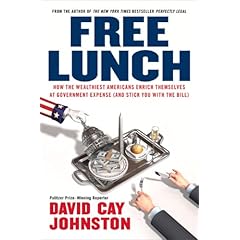
David Cay Johnston, took a look at income patterns in the U.S. over the past few decades in his new book, “Free Lunch: How the Wealthiest Americans Enrich Themselves at Government Expense (and Stick You With the Bill).”


From 1980 to 2005 the national economy, adjusted for inflation, more than doubled. (Because of population growth, the actual increase per capita was about 66 percent.) But the average income for the vast majority of Americans actually declined during that period. The standard of living for the average family has improved not because incomes have grown, but because women have gone into the workplace in droves.

90 percent of the population missed out on the income gains during the sacredly touted 'economic expansion' of the Reagan-Bush Republican Eras

The peak income year for the bottom 90 percent of Americans was way back in 1973 — when the average income per taxpayer (adjusted for inflation) was $33,001. That is nearly $4,000 higher than the average in 2005.


It’s incredible but true: 90 percent of the population missed out on the income gains during that long period.

Mr. Johnston does not mince words: “The pattern here is clear. The rich are getting fabulously richer, the vast majority are somewhat worse off, and the bottom half — for all practical purposes, the poor — are being savaged by our current economic policies.”


.....

For ordinary Americans, jobs are the be-all and end-all. And an America awash in new jobs will require a political environment that respects and rewards work and aggressively pursues creative policies designed to radically expand employment.


Kevin Phillips, a former supporter of Reagan and his policies, also radically changed his mind as he has documented the rich getting far richer much faster while working families have drastically lost ground under the republicans since 1980.

As Rich and others note, the Republican candidates are looking longingly into the past -- almost 30 years past! But the economic reality of these past 30 years will likely continue to show that invoking Reagan to democrats and working Americans is rocky territory fraught with danger and filled with fairy-tales and lies.

Even our British allies are giddy with anticipation of an election change: Just one more year! Good riddance to George W Bush.

Rich's column is already available here; Dowd's is here.


Technorati Tags:
, , , ,


Labels: , , , , , , , , , ,

Thursday, November 01, 2007

Boycott Dubai: Justice for Alex (and other children)

This must be the model for the legal system and executive powers that Darth Cheney aspires to. No wonder they moved Halliburton's corporate headquarters there. But if you're foreign born -- you better not expect justice. Wow. Strikingly similar to the Police States of America.

Overview:

Alex says he was rushing to meet his father for dinner when he bumped into an acquaintance, a 17-year-old native-born student at the American school, who said he and his cousin could drop Alex off at home.

There were, in fact, three Emirati men in the car, including a pair of former convicts ages 35 and 18, according to Alex. He says they drove him past his house and into a dark patch of desert, between a row of new villas and a power plant, took away his cellphone, threatened him with a knife and a club, and told him they would kill his family if he ever reported them.

Then they stripped off his pants and one by one sodomized him in the back seat of the car. They dumped Alex across from one of Dubai’s luxury hotel towers.

Alex and his family were about to learn that despite Dubai’s status as the Arab world’s paragon of modernity and wealth, and its well-earned reputation for protecting foreign investors, its criminal legal system remains a perilous gantlet when it comes to homosexuality and protection of foreigners.

The authorities not only discouraged Alex from pressing charges, he, his family and French diplomats say; they raised the possibility of charging him with criminal homosexual activity, and neglected for weeks to inform him or his parents that one of his attackers had tested H.I.V. positive while in prison four years earlier.

“They tried to smother this story,” Alex said by phone from Switzerland, where he fled a month into his 10th-grade school year, fearing a jail term in Dubai if charged with homosexual activity. “Dubai, they say we build the highest towers, they have the best hotels. But all the news, they hide it. They don’t want the world to know that Dubai still lives in the Middle Ages.”

Alex and his parents say they chose to go public with his case in the hope that it would press the authorities to prosecute the men.

United Arab Emirates law does not recognize rape of males, only a crime called “forced homosexuality.” The two adult men charged with sexually assaulting Alex have pleaded not guilty, although sperm from all three were found in Alex. The two adults appeared in court on Wednesday and were appointed a lawyer. They face trial before a three-judge panel on Nov. 7. The third, a minor, will be tried in juvenile court. Legal experts here say that men convicted of sexually assaulting other men usually serve sentences ranging from a few months to two years.

BoycottDubai.com

Full story at NYT

Technorati Tags: , , , , ,

Labels: , , , ,

Thursday, September 13, 2007

Friedman: Iraq Through China’s Lens, China & Iraq Through Friedman's New Lens

Even Thomas Friedman Finally Admits
'I WAS WRONG'
(plus another bicycle story of note)

Iraq is a Complete and Utter Failure -- and a waste of American Lives and more than half a Trillion Dollars*


September 12, 2007
Op-Ed Columnist
Iraq Through China’s Lens

By THOMAS L. FRIEDMAN
Dalian, China

It’s nice to be in a country where Iraq is never mentioned. It’s just a little unnerving when that country is America’s biggest geopolitical and economic rival these days: China.

I heard China’s prime minister, Wen Jiabao, address an international conference here in Dalian, and what impressed me most was how boring it was — a straightforward recitation of the staggering economic progress China has made in the last two decades and the towering economic, political and environmental challenges it still faces.

How nice it must be, I thought, to be a great power and be almost entirely focused on addressing your own domestic problems?

No, I have not gone isolationist. America has real enemies that China does not, and therefore we have to balance a global security role in places like the Middle East with domestic demands.

But something is out of balance with America today. Looking at the world from here, it is hard not to feel that China has spent the last six years training for the Olympics while we’ve spent ourselves into debt on iPods and Al Qaeda.

After 9/11, we tried to effect change in the heart of the Arab-Muslim world by trying to build a progressive government in Baghdad. There was, I believed, a strategic and moral logic for that. But the strategy failed, for a million different reasons, and now it is time to recognize that and focus on how we insulate ourselves from the instability of that world — by having a real energy policy, for starters — how we protect our security interests there in more sustainable ways and how we get back to developing our own house.

By now it should be clear that Iraq is going to be what it is going to be. We’ve never had sufficient troops there to shape Iraq in our own image. We simply can’t go on betting so many American soldiers and resources that Iraqis will one day learn to live together on their own — without either having to be bludgeoned by Saddam or baby-sat by us.

So either we get help or get out. That is, if President Bush believes staying in Iraq can still make a difference, then he needs to muster some allies because the American people are not going to sustain alone — nor should they — a long-shot bet that something decent can still be built in Baghdad.

If the president can’t get help, then he has to initiate a phased withdrawal: now. Because the opportunity cost this war is exacting on our country and its ability to focus on anything else is out of all proportion to what might still be achieved in Iraq by our staying, with too few troops and too few friends.

Iraqis can add. The surge has brought more calm to Iraq largely because the mainstream Iraqi Sunnis finally calculated that they have lost and that both the pro-Al Qaeda Iraqi Sunnis and the radical Shiites are more of a threat to them than the Americans they had been shooting at.

The minute we start withdrawing, all Iraqis will carefully calculate their interests. They may decide that they want more blood baths, but there is just as much likelihood that they will eventually find equilibrium.

I have not been to Dalian in three years. It is not just a nice city for China. It is a beautiful city of wide avenues, skyscrapers, green spaces, software parks and universities.

The president of Dalian University of Technology, Jinping Ou, told me his new focus now is on energy research and that he has 100 doctoral students dealing with different energy problems — where five years ago he barely had any — and that the Chinese government has just decided to open its national energy innovation research center here.

Listening to him, my mind drifted back to Iraq, where I was two weeks ago and where I heard a U.S. officer in Baghdad tell this story:

His unit was on a patrol in a Sunni neighborhood when it got hit by an I.E.D. Fortunately, the bomb exploded too soon and no one was hurt. His men jumped out and followed the detonation wire, which led 1,500 feet into the neighborhood. A U.S. Black Hawk helicopter was in the area and alerted the U.S. soldiers that a man was fleeing the scene on a bicycle. The soldiers asked the Black Hawk for help, and it swooped down and used its rotor blades to blow the insurgent off his bicycle, with a giant “whoosh,” and the U.S. soldiers captured him.

That image of a $6 million high-tech U.S. helicopter with a highly trained pilot blowing an insurgent off his bicycle captures the absurdity of our situation in Iraq. The great Lebanese historian Kamal Salibi said it best: “Great powers should never get involved in the politics of small tribes.”

That is where we are in Iraq. We’re wasting our brains. We’re wasting our people. We’re wasting our future. China is not.


select.nytimes.com


*$540 Billion Dollars that we know about so far.


Technorati Tags:


Labels: , , ,

Monday, September 10, 2007

Frank Rich: As the Iraqis Stand Down, We’ll Stand Up


As the Iraqis Stand Down, We’ll Stand Up


The New Iraq Narrative

by Frank Rich

OPED Columnist

NYTimes, Sunday, September 9, 2007


It will be all 9/11 all the time this week, as the White House yet again synchronizes its drumbeating for the Iraq war with the anniversary of an attack that had nothing to do with Iraq. Ignore that fog and focus instead on another date whose anniversary passed yesterday without notice: Sept. 8, 2002. What happened on that Sunday five years ago is the Rosetta Stone for the administration's latest scam.

That was the morning when the Bush White House officially rolled out its fraudulent case for the war. The four horsemen of the apocalypse — Cheney, Rumsfeld, Powell and Rice — were dispatched en masse to the Washington talk shows, where they eagerly pointed to a front-page New York Times article amplifying subsequently debunked administration claims that Saddam had sought to buy aluminum tubes meant for nuclear weapons. "We don't want the smoking gun to be a mushroom cloud," said Condoleezza Rice on CNN, introducing a sales pitch concocted by a White House speechwriter.

What followed was an epic propaganda onslaught of distorted intelligence, fake news, credulous and erroneous reporting by bona fide journalists, presidential playacting and Congressional fecklessness. Much of it had been plotted that summer of 2002 by the then-secret White House Iraq Group (WHIG), a small task force of administration brass charged with the Iraq con job.

Today the spirit of WHIG lives. In the stay-the-surge propaganda offensive that crests with this week's Congressional testimony of Gen. David Petraeus and Ambassador Ryan Crocker, history is repeating itself in almost every particular. Even the specter of imminent "nuclear holocaust" has been rebooted in President Bush's arsenal of rhetorical scare tactics.

The new WHIG is a 24/7 Pentagon information "war room" conceived in the last throes of the Rumsfeld regime and run by a former ABC News producer. White House "facts" about the surge's triumph are turning up unsubstantiated in newspapers and on TV. Instead of being bombarded with dire cherry-picked intelligence about W.M.D., this time we're being serenaded with feel-good cherry-picked statistics offering hope. Once again the fix is in. Mr. Bush's pretense that he has been waiting for the Petraeus-Crocker report before setting his policy is as bogus as his U.N. charade before the war. And once again a narrowly Democratic Senate lacks the votes to stop him.

As always with this White House, telegenic artificial realities are paramount. Exhibit A, of course, was last weekend's precisely timed "surprise" presidential junket: Mr. Bush took the measure of success "on the ground here in Anbar" (as he put it) without ever leaving a heavily fortified American base.

A more elaborate example of administration Disneyland can be found in those bubbly Baghdad markets visited by John McCain and other dignitaries whenever the cameras roll. Last week The Washington Post discovered that at least one of them, the Dora market, is a Potemkin village, open only a few hours a day and produced by $2,500 grants (a k a bribes) bestowed on the shopkeepers. "This is General Petraeus's baby," Staff Sgt. Josh Campbell told The Post. "Personally, I think it's a false impression." Another U.S. officer said that even shops that "sell dust" or merely "intend to sell goods" are included in the Pentagon's count of the market's reopened businesses.

One Baghdad visitor left unimpressed was Representative Jan Schakowsky, a Democrat from Chicago, who dined with her delegation in Mr. Crocker's Green Zone residence last month while General Petraeus delivered his spiel. "He's spending an awful lot of time wining and dining members of Congress," she told me last week. Though the menu included that native specialty lobster tortellini, the real bill of fare, Ms. Schakowsky said, was a rigid set of talking points: "Anbar," "bottom up," "decrease in violence" and "success."

In this new White House narrative, victory has been downsized to a successful antiterrorist alliance between Sunni tribal leaders and the American military in Anbar, a single province containing less than 5 percent of Iraq's population. In truth, the surge had little to do with this development, which was already being trumpeted by Mr. Bush in his January prime-time speech announcing the surge.

Even if you believe that it's a good idea to bond with former Saddamists who may have American blood on their hands, the chances of this "bottom up" model replicating itself are slim. Anbar's population is almost exclusively Sunni. Much of the rest of Iraq is consumed by the Sunni-Shiite and Shiite-Shiite civil wars that are M.I.A. in White House talking points.

The "decrease in violence" fable is even more insidious. Though both General Petraeus and a White House fact sheet have recently boasted of a 75 percent decline in sectarian attacks, this number turns out to be as cooked as those tallies of Saddam's weapons sites once peddled by WHIG. As The Washington Post reported on Thursday, it excludes Shiite-on-Shiite and Sunni-on-Sunni violence. The Government Accountability Office, which rejected that fuzzy math, found overall violence unchanged using the methodology practiced by the C.I.A. and the Defense Intelligence Agency.

No doubt General Petraeus, like Dick Cheney before him, will say that his own data is "pretty well confirmed" by classified intelligence that can't be divulged without endangering national security. Meanwhile, the White House will ruthlessly undermine any reality-based information that contradicts its propaganda, much as it dismissed the accurate W.M.D. findings of the United Nations weapon experts Hans Blix and Mohammed ElBaradei before the war. General Petraeus intervened to soften last month's harsh National Intelligence Estimate on Iraq (.pdf). Last week the administration and its ideological surrogates were tireless in trashing the nonpartisan G.A.O. report card that found the Iraqi government flunking most of its benchmarks.

Those benchmarks, the war's dead- enders now say, are obsolete anyway. But what about the president's own benchmarks? Remember "as the Iraqis stand up, we'll stand down"? General Petraeus was once in charge of the Iraqi Army's training and proclaimed it "on track and increasing in capacity" three years ago. On Thursday, an independent commission convened by the Republican John Warner and populated by retired military officers and police chiefs reported that Iraqi forces can take charge no sooner than 12 to 18 months from now, and that the corrupt Iraqi police force has to be rebuilt from scratch. Let us not forget, either, Mr. Bush's former top-down benchmarks for measuring success: "an Iraq that can govern itself, sustain itself and defend itself." On that scorecard, he's batting 0 for 3.

What's surprising is not that this White House makes stuff up, but that even after all the journalistic embarrassments in the run-up to the war its fictions can still infiltrate the real news. After Michael O'Hanlon and Kenneth Pollack, two Brookings Institution scholars, wrote a New York Times Op-Ed article in July spreading glad tidings of falling civilian fatality rates, they were widely damned for trying to pass themselves off as tough war critics (both had supported the war and the surge) and for not mentioning that their fact-finding visit to Iraq was largely dictated by a Department of Defense itinerary.

But this has not impeded them from posing as quasi-journalistic independent observers elsewhere ever since, whether on CNN, CBS, Fox or in these pages, identifying themselves as experts rather than Pentagon junketeers. Unlike Armstrong Williams, the talking head and columnist who clandestinely received big government bucks to "regularly comment" on No Child Left Behind, they received no cash. But why pay for what you can get free? Two weeks ago Mr. O'Hanlon popped up on The Washington Post op-ed page, again pushing rosy Iraq scenarios, including an upbeat prognosis for economic reconstruction, even though the G.A.O. found that little of the $10 billion earmarked for reconstruction is likely to be spent.

Anchoring the "CBS Evening News" from Iraq last week, Katie Couric seemed to be drinking the same Kool-Aid (or eating the same lobster tortellini) as Mr. O'Hanlon. As "a snapshot of what's going right," she cited Falluja, a bombed-out city with 80 percent unemployment, and she repeatedly spoke of American victories against "Al Qaeda." Channeling the president's bait-and-switch, she never differentiated between that local group he calls "Al Qaeda in Iraq" and the Qaeda that attacked America on 9/11. Al Qaeda in Iraq, which didn't even exist on 9/11, may represent as little as 2 to 5 percent of the Sunni insurgency, according to a new investigation in The Washington Monthly by Andrew Tilghman, a former Iraq correspondent for Stars and Stripes.

Next to such "real" news from CBS, the "fake" news at the network's corporate sibling Comedy Central was, not for the first time, more trustworthy. Rob Riggle, a "Daily Show" correspondent who also serves in the Marine Reserve, invited American troops in Iraq to speak candidly about the Iraqi Parliament's vacation.

When the line separating spin from reality is so effectively blurred, the White House's propaganda mission has once more been accomplished. No wonder President Bush is cocky again. Stopping in Sydney for the economic summit after last weekend's photo op in Iraq, he reportedly told Australia's deputy prime minister that "we're kicking ass." This war has now gone on so long that perhaps he has forgotten the price our troops paid the last time he taunted our adversaries to bring it on, some four years and 3,500 American military fatalities ago.


Technorati Tags:
, , , ,


Labels: , , , , , , , , , , , , ,

Tuesday, August 07, 2007

Frank Rich: Patriots Who Love the Troops to Death

FRANK RICH: Patriots Who Love the Troops to Death

Gerald Ford spoke the truth when he called Watergate “our long national nightmare,” but even a nightmare can have its interludes of rib-splitting farce.

None were zanier than the antics of Baruch Korff, a small-town New England rabbi who became a full-time Richard Nixon sycophant as the walls closed in. Korff was ubiquitous in the press and on television, where he would lambaste Democrats and the media “lynch mob” for vilifying “the greatest president of the century.” Despite Nixon’s reflexive anti-Semitism, he returned the favor by granting the rabbi audiences and an interview that allowed the embattled president to soliloquize about how his own faith and serenity reinforced his conviction “deep inside” that everything he did was right.

Clearly we’ve reached our own Korffian moment in our latest long national nightmare. The Nixon interviewed by the rabbi sounded uncannily like the resolute leader chronicled by the conservative columnists and talk-show jocks President Bush has lately welcomed into his bunker. For his part, William Kristol even published a Korffian manifesto, “Why Bush Will Be a Winner,” in The Washington Post. It reassured us that the Bush presidency would “probably be a successful one” and that “we now seem to be on course to a successful outcome” in Iraq. A Bush flack let it be known that the president liked this piece so much that he recommended it to his White House staff.

Are you laughing yet? Maybe not. No one died in Watergate. This time around, the White House lying and cover-ups have been not just in the service of political thuggery but to gin up a gratuitous war without end.

There is another significant difference as well. Washington never drank the Nixon Kool-Aid. It kept a skeptical bipartisan eye on Tricky Dick throughout his political career, long before the Watergate complex had even been built. The charmed Mr. Bush, by contrast, got a free pass; both Democrats and Republicans in Congress and both liberals and conservatives in the news media were credulous enablers of the Iraq fiasco. Now a reckoning awaits, and the denouement is getting ugly.

The ranks of unreconstructed Iraq hawks are thinner than they used to be. Some politicians in both parties (John Edwards, Chris Dodd, Gordon Smith) and truculent pundits (Peter Beinart, Andrew Sullivan) who cheered on the war recanted (sooner in some cases than others), learned from their errors and moved on. One particularly eloquent mea culpa can be found in today’s New York Times Magazine, where the former war supporter Michael Ignatieff acknowledges that those who “truly showed good judgment on Iraq” might have had no more information than those who got it wrong, but did not make the mistake of confusing “wishes for reality.”

But those who remain dug in are having none of that. Some of them are busily lashing out Korff-style. Some are melting down. Some are rewriting history. Most seem more interested in saving their own reputations than the American troops they ritualistically invoke to bludgeon the wars’ critics and to parade their own self-congratulatory patriotism.

It was a rewriting of history that made the blogosphere (and others) go berserk last week over an Op-Ed article in The Times, “A War We Just Might Win,” by Michael O’Hanlon and Kenneth Pollack. The two Brookings Institution scholars, after a government-guided tour, pointed selectively to successes on the ground in Iraq in arguing that the surge should be continued “at least into 2008.”

The hole in their argument was gaping. As Adm. Michael Mullen, the next chairman of the Joint Chiefs, said honorably and bluntly in his Congressional confirmation hearings, “No amount of troops in no amount of time will make much of a difference” in Iraq if there’s no functioning Iraqi government. Opting for wishes over reality, Mr. O’Hanlon and Mr. Pollack buried their pro forma acknowledgment of that huge hurdle near the end of their piece.

But even more galling was the authors’ effort to elevate their credibility by describing themselves as “analysts who have harshly criticized the Bush administration’s miserable handling of Iraq.” That’s disingenuous. For all their late-in-the-game criticisms of the administration’s incompetence, Mr. Pollack proselytized vociferously for the war before it started, including in an appearance with Oprah, and both men have helped prolong the quagmire with mistakenly optimistic sightings of progress since the days of “Mission Accomplished.”

You can find a compendium of their past wisdom in Glenn Greenwald’s Salon column. That think-tank pundits with this track record would try to pass themselves off as harsh war critics in 2007 shows how desperate they are to preserve their status as Beltway “experts” now that the political winds have shifted. Such blatant careerism would be less offensive if they didn’t do so on the backs of the additional American troops they ask to be sacrificed to the doomed mission of providing security for an Iraqi government that is both on vacation and on the verge of collapse.

At least the more rabid and Korff-like of the war’s last defenders have the intellectual honesty not to deny what they’ve been saying all along. But their invective has gone over the top, with even mild recent critics of the war like John Warner and Richard Lugar being branded defeatist “pre- 9/11 Republicans” by Mr. Kristol.

It’s also the tic of Mr. Kristol’s magazine, The Weekly Standard (and its Murdoch sibling The New York Post), to claim that the war’s critics hate the troops. When The New Republic ran a less-than-jingoistic essay by a pseudonymous American soldier in Iraq, The Weekly Standard even accused it of fabrication — only to have its bluff called when the author’s identity was revealed and his controversial anecdotes were verified by other sources.

A similar over-the-top tirade erupted on “Meet the Press” last month, when another war defender in meltdown, Senator Lindsey Graham, repeatedly cut off his fellow guest by saying that soldiers he met on official Congressional visits to Iraq endorsed his own enthusiasm for the surge. Unfortunately for Mr. Graham, his sparring partner was Jim Webb, the take-no-prisoners Virginia Democrat who is a Vietnam veteran and the father of a soldier serving in the war. Senator Webb reduced Mr. Graham to a stammering heap of Jell-O when he chastised him for trying to put his political views “into the mouths of soldiers.” As Mr. Webb noted, the last New York Times-CBS News poll on the subject found that most members of the military and their immediate families have turned against the war, like other Americans.

As is becoming clearer than ever in this Korffian endgame, hiding behind the troops is the last refuge of this war’s sponsors. This too is a rewrite of history. It has been the war’s champions who have more often dishonored the troops than the war’s opponents.

Mr. Bush created the template by doing everything possible to keep the sacrifice of American armed forces in Iraq off-camera, forbidding photos of coffins and skipping military funerals. That set the stage for the ensuing demonization of Ted Koppel, whose decision to salute the fallen by reading a list of their names in the spotlight of “Nightline” was branded unpatriotic by the right’s vigilantes.

The same playbook was followed by the war’s champions when a soldier confronted Donald Rumsfeld about the woeful shortage of armor during a town-hall meeting in Kuwait in December 2004. Rather than campaign for the armor the troops so desperately needed, the right attacked the questioner for what Rush Limbaugh called his “near insubordination.” When The Washington Post some two years later exposed the indignities visited upon the grievously injured troops at Walter Reed Medical Center, The Weekly Standard and the equally hawkish Wall Street Journal editorial page took three weeks to notice, with The Standard giving the story all of two sentences. Protecting the White House from scandal, not the troops from squalor, was the higher priority.

One person who has had enough of this hypocrisy is the war critic Andrew J. Bacevich, a Boston University professor of international relations who is also a Vietnam veteran, a product of the United States Military Academy and a former teacher at West Point. After his 27-year-old son was killed in May while serving in Iraq, he said that Americans should not believe Memorial Day orators who talk about how priceless the troops’ lives are.

“I know what value the U.S. government assigns to a soldier’s life,” Professor Bacevich wrote in The Washington Post. “I’ve been handed the check.” The amount, he said, was “roughly what the Yankees will pay Roger Clemens per inning.”

Anyone who questions this bleak perspective need only have watched last week’s sad and ultimately pointless Congressional hearings into the 2004 friendly-fire death of Pat Tillman. Seven investigations later, we still don’t know who rewrote the witness statements of Tillman’s cohort so that Pentagon propagandists could trumpet a fictionalized battle death to the public and his family.

But it was nonetheless illuminating to watch Mr. Rumsfeld and his top brass sit there under oath and repeatedly go mentally AWOL about crucial events in the case. Their convenient mass amnesia about their army’s most famous and lied-about casualty is as good a definition as any of just what “supporting the troops” means to those who even now beat the drums for this war.

Technorati Tags:
,


Labels: , , , ,

Monday, July 30, 2007

Frank Rich: Who Really Took Over During That Colonoscopy? (Protecting the Prez)

Who Really Took Over During That Colonoscopy


By FRANK RICH
NYTimes Op-Ed Columnist
July 29, 2007

THERE was, of course, gallows humor galore when Dick Cheney briefly grabbed the wheel of our listing ship of state during the presidential colonoscopy last weekend. Enjoy it while it lasts. A once-durable staple of 21st-century American humor is in its last throes. We have a new surrogate president now. Sic transit Cheney. Long live David Petraeus!

It was The Washington Post that first quantified General Petraeus’s remarkable ascension. President Bush, who mentioned his new Iraq commander’s name only six times as the surge rolled out in January, has cited him more than 150 times in public utterances since, including 53 in May alone.

"...the Petraeus phenomenon is not about protecting the troops or American interests but about protecting the president."


As always with this White House’s propaganda offensives, the message in Mr. Bush’s relentless repetitions never varies. General Petraeus is the “main man.” He is the man who gives “candid advice.” Come September, he will be the man who will give the president and the country their orders about the war.

And so another constitutional principle can be added to the long list of those junked by this administration: the quaint notion that our uniformed officers are supposed to report to civilian leadership. In a de facto military coup, the commander in chief is now reporting to the commander in Iraq. We must “wait to see what David has to say,” Mr. Bush says.

Actually, we don’t have to wait. We already know what David will say. He gave it away to The Times of London last month, when he said that September “is a deadline for a report, not a deadline for a change in policy.” In other words: Damn the report (and that irrelevant Congress that will read it) — full speed ahead. There will be no change in policy. As Michael Gordon reported in The New York Times last week, General Petraeus has collaborated on a classified strategy document that will keep American troops in Iraq well into 2009 as we wait for the miracles that will somehow bring that country security and a functioning government.

Though General Petraeus wrote his 1987 Princeton doctoral dissertation on “The American Military and the Lessons of Vietnam,” he has an unshakable penchant for seeing light at the end of tunnels. It has been three Julys since he posed for the cover of Newsweek under the headline “Can This Man Save Iraq?” The magazine noted that the general’s pacification of Mosul was “a textbook case of doing counterinsurgency the right way.” Four months later, the police chief installed by General Petraeus defected to the insurgents, along with most of the Sunni members of the police force. Mosul, population 1.7 million, is now an insurgent stronghold, according to the Pentagon’s own June report.

By the time reality ambushed his textbook victory, the general had moved on to the mission of making Iraqi troops stand up so American troops could stand down. “Training is on track and increasing in capacity,” he wrote in The Washington Post in late September 2004, during the endgame of the American presidential election. He extolled the increased prowess of the Iraqi fighting forces and the rebuilding of their infrastructure.

The rest is tragic history. Were the Iraqi forces on the trajectory that General Petraeus asserted in his election-year pep talk, no “surge” would have been needed more than two years later. We would not be learning at this late date, as we did only when Gen. Peter Pace was pressed in a Pentagon briefing this month, that the number of Iraqi battalions operating independently is in fact falling — now standing at a mere six, down from 10 in March.

"...another constitutional principle can be added to the long list of those junked by this administration: the quaint notion that our uniformed officers are supposed to report to civilian leadership."


But even more revealing is what was happening at the time that General Petraeus disseminated his sunny 2004 prognosis. The best account is to be found in “The Occupation of Iraq,” the authoritative chronicle by Ali Allawi published this year by Yale University Press. Mr. Allawi is not some anti-American crank. He was the first civilian defense minister of postwar Iraq and has been an adviser to Prime Minister Nuri al-Maliki; his book was praised by none other than the Iraq war cheerleader Fouad Ajami as “magnificent.”

Mr. Allawi writes that the embezzlement of the Iraqi Army’s $1.2 billion arms procurement budget was happening “under the very noses” of the Security Transition Command run by General Petraeus: “The saga of the grand theft of the Ministry of Defense perfectly illustrated the huge gap between the harsh realities on the ground and the Panglossian spin that permeated official pronouncements.” Mr. Allawi contrasts the “lyrical” Petraeus pronouncements in The Post with the harsh realities of the Iraqi forces’ inoperable helicopters, flimsy bulletproof vests and toy helmets. The huge sums that might have helped the Iraqis stand up were instead “handed over to unscrupulous adventurers and former pizza parlor operators.”

Well, anyone can make a mistake. And when General Petraeus cited soccer games as an example of “the astonishing signs of normalcy” in Baghdad last month, he could not have anticipated that car bombs would kill at least 50 Iraqis after the Iraqi team’s poignant victory in the Asian Cup semifinals last week. This general may well be, as many say, the brightest and bravest we have. But that doesn’t account for why he has been invested by the White House and its last-ditch apologists with such singular power over the war.

On “Meet the Press,” Lindsey Graham, one of the Senate’s last gung-ho war defenders in either party, mentioned General Petraeus 10 times in one segment, saying he would “not vote for anything” unless “General Petraeus passes on it.” Desperate hawks on the nation’s op-ed pages not only idolize the commander daily but denounce any critics of his strategy as deserters, defeatists and enemies of the troops.

That’s because the Petraeus phenomenon is not about protecting the troops or American interests but about protecting the president. For all Mr. Bush’s claims of seeking “candid” advice, he wants nothing of the kind. He sent that message before the war, with the shunting aside of Eric Shinseki, the general who dared tell Congress the simple truth that hundreds of thousands of American troops would be needed to secure Iraq. The message was sent again when John Abizaid and George Casey were supplanted after they disagreed with the surge.

Two weeks ago, in his continuing quest for “candid” views, Mr. Bush invited a claque consisting exclusively of conservative pundits to the White House and inadvertently revealed the real motive for the Petraeus surrogate presidency. “The most credible person in the fight at this moment is Gen. David Petraeus,” he said, in National Review’s account.

To be the “most credible” person in this war team means about as much as being the most sober tabloid starlet in the Paris-Lindsay cohort. But never mind. What Mr. Bush meant is that General Petraeus is famous for minding his press coverage, even to the point of congratulating the ABC News anchor Charles Gibson for “kicking some butt” in the Nielsen ratings when Mr. Gibson interviewed him last month. The president, whose 65 percent disapproval rating is now just one point shy of Richard Nixon’s pre-resignation nadir, is counting on General Petraeus to be the un-Shinseki and bestow whatever credibility he has upon White House policies and pronouncements.

He is delivering, heaven knows. Like Mr. Bush, he has taken to comparing the utter stalemate in the Iraqi Parliament to “our own debates at the birth of our nation,” as if the Hamilton-Jefferson disputes were akin to the Shiite-Sunni bloodletting. He is also starting to echo the administration line that Al Qaeda is the principal villain in Iraq, a departure from the more nuanced and realistic picture of the civil-war-torn battlefront he presented to Senate questioners in his confirmation hearings in January.

Mr. Bush has become so reckless in his own denials of reality that he seems to think he can get away with saying anything as long as he has his “main man” to front for him. The president now hammers in the false litany of a “merger” between Osama bin Laden’s Al Qaeda and what he calls “Al Qaeda in Iraq” as if he were following the Madison Avenue script declaring that “Cingular is now the new AT&T.” He doesn’t seem to know that nearly 40 other groups besides Al Qaeda in Mesopotamia have adopted Al Qaeda’s name or pledged allegiance to Osama bin Laden worldwide since 2003, by the count of the former C.I.A. counterterrorism official Michael Scheuer. They may follow us here well before any insurgents in Iraq do.

On Tuesday — a week after the National Intelligence Estimate warned of the resurgence of bin Laden’s Qaeda in Pakistan — Mr. Bush gave a speech in which he continued to claim that “Al Qaeda in Iraq” makes Iraq the central front in the war on terror. He mentioned Al Qaeda 95 times but Pakistan and Pervez Musharraf not once. Two days later, his own top intelligence officials refused to endorse his premise when appearing before Congress. They are all too familiar with the threats that are building to a shrill pitch this summer.

Should those threats become a reality while America continues to be bogged down in Iraq, this much is certain: It will all be the fault of President Petraeus.


Original source: Who Really Took Over During That Colonoscopy

More Articles by Frank Rich

Labels: , , , , , ,

Monday, July 16, 2007

Paul Krugman: The Waiting Game

PAUL KRUGMAN

NY Times Columnist

Sunday, July 15, 2007


Being without health insurance is no big deal. Just ask President Bush. “I mean, people have access to health care in America,” he said last week. “After all, you just go to an emergency room.”

This is what you might call callousness with consequences. The White House has announced that Mr. Bush will veto a bipartisan plan that would extend health insurance, and with it such essentials as regular checkups and preventive medical care, to an estimated 4.1 million currently uninsured children. After all, it’s not as if those kids really need insurance — they can just go to emergency rooms, right?

O.K., it’s not news that Mr. Bush has no empathy for people less fortunate than himself. But his willful ignorance here is part of a larger picture: by and large, opponents of universal health care paint a glowing portrait of the American system that bears as little resemblance to reality as the scare stories they tell about health care in France, Britain, and Canada.

The claim that the uninsured can get all the care they need in emergency rooms is just the beginning. Beyond that is the myth that Americans who are lucky enough to have insurance never face long waits for medical care.

Actually, the persistence of that myth puzzles me. I can understand how people like Mr. Bush or Fred Thompson, who declared recently that “the poorest Americans are getting far better service” than Canadians or the British, can wave away the desperation of uninsured Americans, who are often poor and voiceless. But how can they get away with pretending that insured Americans always get prompt care, when most of us can testify otherwise?

A recent article in Business Week put it bluntly: “In reality, both data and anecdotes show that the American people are already waiting as long or longer than patients living with universal health-care systems.”

A cross-national survey conducted by the Commonwealth Fund found that America ranks near the bottom among advanced countries in terms of how hard it is to get medical attention on short notice (although Canada was slightly worse), and that America is the worst place in the advanced world if you need care after hours or on a weekend.

We look better when it comes to seeing a specialist or receiving elective surgery. But Germany outperforms us even on those measures — and I suspect that France, which wasn’t included in the study, matches Germany’s performance.

Besides, not all medical delays are created equal. In Canada and Britain, delays are caused by doctors trying to devote limited medical resources to the most urgent cases. In the United States, they’re often caused by insurance companies trying to save money.

This can lead to ordeals like the one recently described by Mark Kleiman, a professor at U.C.L.A., who nearly died of cancer because his insurer kept delaying approval for a necessary biopsy. “It was only later,” writes Mr. Kleiman on his blog, “that I discovered why the insurance company was stalling; I had an option, which I didn’t know I had, to avoid all the approvals by going to ‘Tier II,’ which would have meant higher co-payments.”

He adds, “I don’t know how many people my insurance company waited to death that year, but I’m certain the number wasn’t zero.”

To be fair, Mr. Kleiman is only surmising that his insurance company risked his life in an attempt to get him to pay more of his treatment costs. But there’s no question that some Americans who seemingly have good insurance nonetheless die because insurers are trying to hold down their “medical losses” — the industry term for actually having to pay for care.

On the other hand, it’s true that Americans get hip replacements faster than Canadians. But there’s a funny thing about that example, which is used constantly as an argument for the superiority of private health insurance over a government-run system: the large majority of hip replacements in the United States are paid for by, um, Medicare.

That’s right: the hip-replacement gap is actually a comparison of two government health insurance systems. American Medicare has shorter waits than Canadian Medicare (yes, that’s what they call their system) because it has more lavish funding — end of story. The alleged virtues of private insurance have nothing to do with it.

The bottom line is that the opponents of universal health care appear to have run out of honest arguments. All they have left are fantasies: horror fiction about health care in other countries, and fairy tales about health care here in America.


Technorati Tags:
, , , , , , , , , ,


Labels: , , , ,

Wednesday, July 11, 2007

Maureen Dowd: History as an Alibi

When presidents have screwed up and want to console themselves, they think history will give them .... the historical equivalent of a presidential pardon.


History as an Alibi


By MAUREEN DOWD

NY Times OP-ED Columnist

July 11, 2007


On Friday, Condi Rice played hooky and spent the afternoon at the Tiger Woods golf tournament at Congressional Country Club in suburban Maryland.


She had lunch at the clubhouse with Tiger, who had dedicated the contest to American servicemen. She followed Phil Mickelson and Brad Faxon for a bit, after having them over to the White House on the Fourth to watch the fireworks. She gave interviews about her newfound affection for golf, laughing about her errant drives and “wicked hook.”


Like W. going out boating and fishing in Kennebunkport as Britain and its new prime minister, Gordon Brown, reeled from terrorist attacks, Condi acted as if she didn’t have a care in the world. And why on earth should she?


The homeland security chief, Michael Chertoff, has a gut feeling that a Qaeda cell might be coming or already be here. “Summertime seems to be appealing to them,” he said, sounding more like a meteorologist than the man charged with keeping us safe.


With 30 mortars hitting the Green Zone yesterday and Army recruiting wilting, some Bush advisers are at long last coming around to the Baker-Hamilton report recommendation that they should engage in intense diplomacy with the countries around Iraq.


Someone might tell Condi — who said in one of her golf interviews that her zest for sports is so all-encompassing that “I love anything with a score at the end” — that she’d better get to work or America’s score in Iraq will be zero.


Why they continue to seek counsel from the man who kept the Vietnam War going for years ... is beyond mystifying.


The Iraq war she helped sell has turned into Grendel, devouring everything in sight and making it uninhabitable. It has ravaged Iraq, Bush’s presidency, the federal budget, the Republican majority, American invincibility and integrity, and now, John McCain’s chance to be president.


And there’s no Beowulf in sight. Just a bunch of spectacularly wrong hawks stubbornly continuing to be spectacularly wrong at what an alarmed Republican Senator John Warner calls “a time in our history unlike any I have ever witnessed before.”

Watching the warring tribes in Iraq grow more violent has caused the beginning of a reconciliation among the warring tribes in Washington, as they realize they have to get the car keys away from the careening president who has crashed into the globe.


With Republicans in revolt over the surge and losing patience, and Bushies worried, as one put it to The Washington Post, that “July has become the new September,” the president decided to do a p.r. surge to sound as if he’s acquainted with reality.


But in a speech in Cleveland yesterday, the president was still repeating his deranged generalities. Making a tiny concession, he said we would be able to pull back troops “in a while,” whatever that means, but asked Congress to wait for Gen. David Petraeus to debrief on the surge in September — rather than focus on the report due this week that says the ineffectual Iraq government has failed to meet benchmarks set by America.


It was ironic that his strongest supporter to the bitter end was the Republican who was once his bitter rival. There was speculation that Mr. McCain would come back from his visit to Iraq and revise his bullish support of the war to save his imploding campaign. But the opposite happened.


As his top advisers were purged, Mr. McCain went to the floor of the Senate to reassert his warped view that “there appears to be overall movement in the right direction.”

Like W., Senator McCain values the advice of Henry Kissinger and said, “We can find wisdom in several suggestions put forward recently by Henry Kissinger.”


Why they continue to seek counsel from the man who kept the Vietnam War going for years just to protect Richard Nixon’s electoral chances is beyond mystifying. But Mr. Kissinger holds their attention with all his warnings of “American impotence” emboldening radical Islam and Iran. Can’t W. and Mr. McCain see that American muscularity, stupidly thrown around, has already emboldened radical Islam and Iran?


The president mentioned in his speech yesterday that he was reading history, and he has been summoning historians and theologians to the White House for discussions on the fate of Iraq and the nature of good and evil.


W. thinks history will be his alibi. When presidents have screwed up and want to console themselves, they think history will give them a second chance. It’s the historical equivalent of a presidential pardon.


But there are other things — morality, strategy and security — that are more pressing than history. History is just the fanciest way possible of wanting to deny or distract attention from what’s happening now.


Labels: , , , , , , , ,

Sunday, July 08, 2007

New York Times Editorial: End the War Now, Leave Iraq ASAP

This Editorial calls for a reasoned strategy and draw-down, not immediate withdrawal leaving an already bloody and chaotic situation in even worse chaos. But it is past time to stop the charade, lies and demagoguery. Past Time to SHOUT Truth to Power!

"
Bush and Cheney have used demagoguery and fear to quell Americans’ demands for an end to this war. They say withdrawing will create bloodshed and chaos and encourage terrorists. Actually, all of that has already happened — the result of this unnecessary invasion and the incompetent management of this war.

This country faces a choice. We can go on allowing Mr. Bush to drag out this war without end or purpose. Or we can insist that American troops are withdrawn as quickly and safely as we can manage — with as much effort as possible to stop the chaos from spreading.
"


July 8, 2007
Editorial

The Road Home


It is time for the United States to leave Iraq, without any more delay than the Pentagon needs to organize an orderly exit.

•

Like many Americans, we have put off that conclusion, waiting for a sign that President Bush was seriously trying to dig the United States out of the disaster he created by invading Iraq without sufficient cause, in the face of global opposition, and without a plan to stabilize the country afterward.

At first, we believed that after destroying Iraq’s government, army, police and economic structures, the United States was obliged to try to accomplish some of the goals Mr. Bush claimed to be pursuing, chiefly building a stable, unified Iraq. When it became clear that the president had neither the vision nor the means to do that, we argued against setting a withdrawal date while there was still some chance to mitigate the chaos that would most likely follow.

While Mr. Bush scorns deadlines, he kept promising breakthroughs — after elections, after a constitution, after sending in thousands more troops. But those milestones came and went without any progress toward a stable, democratic Iraq or a path for withdrawal. It is frighteningly clear that Mr. Bush’s plan is to stay the course as long as he is president and dump the mess on his successor. Whatever his cause was, it is lost.

The political leaders Washington has backed are incapable of putting national interests ahead of sectarian score settling. The security forces Washington has trained behave more like partisan militias. Additional military forces poured into the Baghdad region have failed to change anything.

Continuing to sacrifice the lives and limbs of American soldiers is wrong. The war is sapping the strength of the nation’s alliances and its military forces. It is a dangerous diversion from the life-and-death struggle against terrorists. It is an increasing burden on American taxpayers, and it is a betrayal of a world that needs the wise application of American power and principles.

A majority of Americans reached these conclusions months ago. Even in politically polarized Washington, positions on the war no longer divide entirely on party lines. When Congress returns this week, extricating American troops from the war should be at the top of its agenda.

That conversation must be candid and focused. Americans must be clear that Iraq, and the region around it, could be even bloodier and more chaotic after Americans leave. There could be reprisals against those who worked with American forces, further ethnic cleansing, even genocide. Potentially destabilizing refugee flows could hit Jordan and Syria. Iran and Turkey could be tempted to make power grabs. Perhaps most important, the invasion has created a new stronghold from which terrorist activity could proliferate.

The administration, the Democratic-controlled Congress, the United Nations and America’s allies must try to mitigate those outcomes — and they may fail. But Americans must be equally honest about the fact that keeping troops in Iraq will only make things worse. The nation needs a serious discussion, now, about how to accomplish a withdrawal and meet some of the big challenges that will arise.

The Mechanics of Withdrawal

The United States has about 160,000 troops and millions of tons of military gear inside Iraq. Getting that force out safely will be a formidable challenge. The main road south to Kuwait is notoriously vulnerable to roadside bomb attacks. Soldiers, weapons and vehicles will need to be deployed to secure bases while airlift and sealift operations are organized. Withdrawal routes will have to be guarded. The exit must be everything the invasion was not: based on reality and backed by adequate resources.

The United States should explore using Kurdish territory in the north of Iraq as a secure staging area. Being able to use bases and ports in Turkey would also make withdrawal faster and safer. Turkey has been an inconsistent ally in this war, but like other nations, it should realize that shouldering part of the burden of the aftermath is in its own interest.

Accomplishing all of this in less than six months is probably unrealistic. The political decision should be made, and the target date set, now.

The Fight Against Terrorists

Despite President Bush’s repeated claims, Al Qaeda had no significant foothold in Iraq before the invasion, which gave it new base camps, new recruits and new prestige.

This war diverted Pentagon resources from Afghanistan, where the military had a real chance to hunt down Al Qaeda’s leaders. It alienated essential allies in the war against terrorism. It drained the strength and readiness of American troops.

And it created a new front where the United States will have to continue to battle terrorist forces and enlist local allies who reject the idea of an Iraq hijacked by international terrorists. The military will need resources and bases to stanch this self- inflicted wound for the foreseeable future.

The Question of Bases

The United States could strike an agreement with the Kurds to create those bases in northeastern Iraq. Or, the Pentagon could use its bases in countries like Kuwait and Qatar, and its large naval presence in the Persian Gulf, as staging points.

There are arguments for, and against, both options. Leaving troops in Iraq might make it too easy — and too tempting — to get drawn back into the civil war and confirm suspicions that Washington’s real goal was to secure permanent bases in Iraq. Mounting attacks from other countries could endanger those nations’ governments.

The White House should make this choice after consultation with Congress and the other countries in the region, whose opinions the Bush administration has essentially ignored. The bottom line: the Pentagon needs enough force to stage effective raids and airstrikes against terrorist forces in Iraq, but not enough to resume large-scale combat.

The Civil War

One of Mr. Bush’s arguments against withdrawal is that it would lead to civil war. That war is raging, right now, and it may take years to burn out. Iraq may fragment into separate Kurdish, Sunni and Shiite republics, and American troops are not going to stop that from happening.

It is possible, we suppose, that announcing a firm withdrawal date might finally focus Iraq’s political leaders and neighboring governments on reality. Ideally, it could spur Iraqi politicians to take the steps toward national reconciliation that they have endlessly discussed but refused to act on.

But it is foolish to count on that, as some Democratic proponents of withdrawal have done. The administration should use whatever leverage it gains from withdrawing to press its allies and Iraq’s neighbors to help achieve a negotiated solution.

Iraq’s leaders — knowing that they can no longer rely on the Americans to guarantee their survival — might be more open to compromise, perhaps to a Bosnian-style partition, with economic resources fairly shared but with millions of Iraqis forced to relocate. That would be better than the slow-motion ethnic and religious cleansing that has contributed to driving one in seven Iraqis from their homes.

The United States military cannot solve the problem. Congress and the White House must lead an international attempt at a negotiated outcome. To start, Washington must turn to the United Nations, which Mr. Bush spurned and ridiculed as a preface to war.

The Human Crisis

There are already nearly two million Iraqi refugees, mostly in Syria and Jordan, and nearly two million more Iraqis who have been displaced within their country. Without the active cooperation of all six countries bordering Iraq — Turkey, Iran, Kuwait, Saudi Arabia, Jordan and Syria — and the help of other nations, this disaster could get worse. Beyond the suffering, massive flows of refugees — some with ethnic and political resentments — could spread Iraq’s conflict far beyond Iraq’s borders.

Kuwait and Saudi Arabia must share the burden of hosting refugees. Jordan and Syria, now nearly overwhelmed with refugees, need more international help. That, of course, means money. The nations of Europe and Asia have a stake and should contribute. The United States will have to pay a large share of the costs, but should also lead international efforts, perhaps a donors’ conference, to raise money for the refugee crisis.

Washington also has to mend fences with allies. There are new governments in Britain, France and Germany that did not participate in the fight over starting this war and are eager to get beyond it. But that will still require a measure of humility and a commitment to multilateral action that this administration has never shown. And, however angry they were with President Bush for creating this mess, those nations should see that they cannot walk away from the consequences. To put it baldly, terrorism and oil make it impossible to ignore.

The United States has the greatest responsibilities, including the admission of many more refugees for permanent resettlement. The most compelling obligation is to the tens of thousands of Iraqis of courage and good will — translators, embassy employees, reconstruction workers — whose lives will be in danger because they believed the promises and cooperated with the Americans.

The Neighbors

One of the trickiest tasks will be avoiding excessive meddling in Iraq by its neighbors — America’s friends as well as its adversaries.

Just as Iran should come under international pressure to allow Shiites in southern Iraq to develop their own independent future, Washington must help persuade Sunni powers like Syria not to intervene on behalf of Sunni Iraqis. Turkey must be kept from sending troops into Kurdish territories.

For this effort to have any remote chance, Mr. Bush must drop his resistance to talking with both Iran and Syria. Britain, France, Russia, China and other nations with influence have a responsibility to help. Civil war in Iraq is a threat to everyone, especially if it spills across Iraq’s borders.

•

President Bush and Vice President Dick Cheney have used demagoguery and fear to quell Americans’ demands for an end to this war. They say withdrawing will create bloodshed and chaos and encourage terrorists. Actually, all of that has already happened — the result of this unnecessary invasion and the incompetent management of this war.

This country faces a choice. We can go on allowing Mr. Bush to drag out this war without end or purpose. Or we can insist that American troops are withdrawn as quickly and safely as we can manage — with as much effort as possible to stop the chaos from spreading.

Labels: , , , , , , , , , , , , , , , ,

Progressive Women Bloggers Ring
Power By Ringsurf