Amazon.com Widgets

Saturday, January 19, 2008

Sunday's NYTimes Editorial Columns by Rich & Dowd: Bush & Reagan Bucket List Republicans Living In the Past & In Denial

Frank Rich's Sunday Column is entitled: Ronald Reagan Is Still Dead.

Never mind that the G.O.P. is running on empty, with no ideas beyond the incessant repetition of Reagan’s name. ....the Clintons are hardly bigots, and the Democratic candidates all have a history of fighting strenuously for inclusiveness. By contrast, the Romney victory in Michigan is another reminder of how Republicans aren’t even playing in the same multiracial [or economic] American sandbox.

George W. Bush has led his party to the brink of disaster and cost it a generation of young Americans

[Romney's] retro persona exemplifies much of the present Republican dilemma. It’s not just that the old Reagan coalition of social, economic and foreign-policy conservatives has fractured. A more indelible problem for the Republicans in 2008 is that their candidates are utterly segregated from reality as it is lived by the overwhelming majority of their fellow Americans. The G.O.P. presidential field’s lack of demographic diversity by age, gender, ethnicity or even wardrobe, let alone race, is simply the leading indicator of how out of touch its brand has become.

Among [the republicans], Mike Huckabee alone made affinity for economically struggling Americans his calling card. Unfortunately, Huckanomics is more snake oil. All federal taxes would be replaced by a national sales tax that despite its Orwellian name (the Fair Tax) would shift more of the burden to middle- and low-income Americans.

Exit polls find that among voters in Republican primaries, as many as half have turned against the president. David Frum, the onetime Bush speechwriter, laments in his provocative new book “Comeback” that by 2008 his former boss “had led his party to the brink of disaster” and cost it “a generation of young Americans.”


MoDo Goes After Shrub and His Feeble Supplications to the Dictators of the Middle East in her column: Red, White and Blue Tag Sale

Hillary Clinton was right when she said it was “pathetic” that President Bush had to beg the Saudis to drop the price of oil.

In Abu Dhabi, he marveled at the royal family’s plans to build a city based entirely upon renewable energy. “Amazing, isn’t it?” W. said.

You know you’re in trouble when your Middle East oil pump is greener than you are.

One cascading rationale he offered for invading Iraq was the benign domino theory, that bringing democracy to Iraq would sway the autocrats in the region to be less repressive.

But when W. visited Saudi Arabia and Egypt last week, he did not have the whip hand. He could not demand anything of the autocrats in the way of more rights for women and dissidents, much less get the Saudis to help on oil production. He needs their help in corralling Iran, which has been puffed up by the occupation of Iraq.

Dowd also mentioned a sign I'd love to see "Hanging on the skyline of New York is a sign reading: “U.S.A. Now a Wholly Owned Subsidiary of Foreign Investors.”


Anyone who thinks a businessman with a 50s sensibility can solve the complex problems of our time is still living in Reagan-world. And we know that his policies are what set in motion the rich getting richer while widening the economic gap at a pace that Shrub Bush and Dick head-guy Cheney have only accelerated.

Bob Herbert's column reminds us of the hard economic facts via a recent Economomic Policy Institute report which states:


“The distribution of wages, income and wealth in the United States has become vastly more unequal over the last 30 years. In fact, this country has a more unequal distribution of income than any other advanced country.”

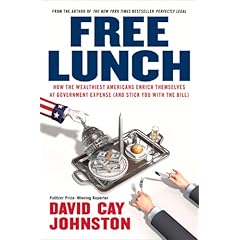
David Cay Johnston, took a look at income patterns in the U.S. over the past few decades in his new book, “Free Lunch: How the Wealthiest Americans Enrich Themselves at Government Expense (and Stick You With the Bill).”


From 1980 to 2005 the national economy, adjusted for inflation, more than doubled. (Because of population growth, the actual increase per capita was about 66 percent.) But the average income for the vast majority of Americans actually declined during that period. The standard of living for the average family has improved not because incomes have grown, but because women have gone into the workplace in droves.

90 percent of the population missed out on the income gains during the sacredly touted 'economic expansion' of the Reagan-Bush Republican Eras

The peak income year for the bottom 90 percent of Americans was way back in 1973 — when the average income per taxpayer (adjusted for inflation) was $33,001. That is nearly $4,000 higher than the average in 2005.


It’s incredible but true: 90 percent of the population missed out on the income gains during that long period.

Mr. Johnston does not mince words: “The pattern here is clear. The rich are getting fabulously richer, the vast majority are somewhat worse off, and the bottom half — for all practical purposes, the poor — are being savaged by our current economic policies.”


.....

For ordinary Americans, jobs are the be-all and end-all. And an America awash in new jobs will require a political environment that respects and rewards work and aggressively pursues creative policies designed to radically expand employment.


Kevin Phillips, a former supporter of Reagan and his policies, also radically changed his mind as he has documented the rich getting far richer much faster while working families have drastically lost ground under the republicans since 1980.

As Rich and others note, the Republican candidates are looking longingly into the past -- almost 30 years past! But the economic reality of these past 30 years will likely continue to show that invoking Reagan to democrats and working Americans is rocky territory fraught with danger and filled with fairy-tales and lies.

Even our British allies are giddy with anticipation of an election change: Just one more year! Good riddance to George W Bush.

Rich's column is already available here; Dowd's is here.


Technorati Tags:
, , , ,


Labels: , , , , , , , , , ,

Monday, September 17, 2007

Frank Rich: Will the Democrats Betray Us?

Will the Democrats Betray Us?


FRANK RICH

OP-ED Columnist

NYTimes

Sunday, September 17, 2007

"SIR, I don't know, actually": The fact that America's surrogate commander in chief, David Petraeus, could not say whether the war in Iraq is making America safer was all you needed to take away from last week's festivities in Washington. Everything else was a verbal quagmire, as administration spin and senatorial preening fought to a numbing standoff.


Not that many Americans were watching. The country knew going in that the White House would win its latest campaign to stay its course of indefinitely shoveling our troops and treasure into the bottomless pit of Iraq. The only troops coming home alive or with their limbs intact in President Bush's troop "reduction" are those who were scheduled to be withdrawn by April anyway. Otherwise the president would have had to extend combat tours yet again, mobilize more reserves or bring back the draft.

On the sixth anniversary of the day that did not change everything, General Petraeus couldn't say we are safer because he knows we are not. Last Sunday, Michael Scheuer, the former chief of the C.I.A.'s Osama bin Laden unit, explained why. He wrote in The Daily News that Al Qaeda, under the de facto protection of Pervez Musharraf, is "on balance" more threatening today that it was on 9/11. And as goes Pakistan, so goes Afghanistan. On Tuesday, just as the Senate hearings began, Lisa Myers of NBC News reported on a Taliban camp near Kabul in an area nominally controlled by the Afghan government we installed. It is training bomb makers to attack America.

Little of this registered in or beyond the Beltway. New bin Laden tapes and the latest 9/11 memorial rites notwithstanding, we're back in a 9/10 mind-set. Bin Laden, said Frances Townsend, the top White House homeland security official, "is virtually impotent." Karen Hughes, the Bush crony in charge of America's P.R. in the jihadists' world, recently held a press conference anointing Cal Ripken Jr. our international "special sports envoy." We are once more sleepwalking through history, fiddling while the Qaeda not in Iraq prepares to burn.

This is why the parallels between Vietnam and Iraq, including those more accurate than Mr. Bush's recent false analogies, can take us only so far. Our situation is graver than it was during Vietnam.


Certainly there were some eerie symmetries between General Petraeus's sales pitch last week and its often-noted historical antecedent: Gen. William Westmoreland's similar mission for L.B.J. before Congress on April 28, 1967. Westmoreland, too, refused to acknowledge that our troops were caught in a civil war. He spoke as well of the "repeated successes" of the American-trained South Vietnamese military and ticked off its growing number of combat-ready battalions. "The strategy we're following at this time is the proper one," the general assured America, and "is producing results."

Those fabulous results delayed our final departure from Vietnam for another eight years — just short of the nine to 10 years General Petraeus has said may be needed for a counterinsurgency in Iraq. But there's a crucial difference between the Westmoreland show of 1967 and the 2007 revival by General Petraeus and Ambassador Ryan Crocker. Westmoreland played to a full and largely enthusiastic house. Most Americans still supported the war in Vietnam and trusted him; so did all but a few members of Congress, regardless of party. All three networks pre-empted their midday programming for Westmoreland's Congressional appearance.

Our Iraq commander, by contrast, appeared before a divided and stalemated Congress just as an ABC News-Washington Post poll found that most Americans believed he would overhype progress in Iraq. No network interrupted a soap opera for his testimony. On cable the hearings fought for coverage with Britney Spears's latest self-immolation and the fate of Madeleine McCann, our latest JonBenet Ramsey stand-in.

General Petraeus and Ambassador Crocker could grab an hour of prime television time only by slinking into the safe foxhole of Fox News, where Brit Hume chaperoned them on a gloomy, bunkerlike set before an audience of merely 1.5 million true believers. Their "Briefing for America," as Fox titled it, was all too fittingly interrupted early on for a commercial promising pharmaceutical relief from erectile dysfunction.

Even if military "victory" were achievable in Iraq, America could not win a war abandoned by its own citizens. The evaporation of that support was ratified by voters last November. For that, they were rewarded with the "surge." Now their mood has turned darker. Americans have not merely abandoned the war; they don't want to hear anything that might remind them of it, or of war in general. Katie Couric's much-promoted weeklong visit to the front produced ratings matching the CBS newscast's all-time low. Angelina Jolie's movie about Daniel Pearl sank without a trace. Even Clint Eastwood's wildly acclaimed movies about World War II went begging. Over its latest season, "24" lost a third of its viewers, just as Mr. Bush did between January's prime-time address and last week's.

You can't blame the public for changing the channel. People realize that the president's real "plan for victory" is to let his successor clean up the mess. They don't want to see American troops dying for that cause, but what can be done? Americans voted the G.O.P. out of power in Congress; a clear majority consistently tell pollsters they want out of Iraq. And still every day is Groundhog Day. Our America, unlike Vietnam-era America, is more often resigned than angry. Though the latest New York Times-CBS News poll finds that only 5 percent trust the president to wrap up the war, the figure for the (barely) Democratic-controlled Congress, 21 percent, is an almost-as-resounding vote of no confidence.

Last week Democrats often earned that rating, especially those running for president. It is true that they do not have the votes to overcome a Bush veto of any war legislation. But that doesn't mean the Democrats have to go on holiday. Few used their time to cross-examine General Petraeus and Ambassador Crocker on their disingenuous talking points, choosing instead to regurgitate stump sentiments or ask uncoordinated, redundant questions. It's telling that the one question that drew blood — are we safer? — was asked by a Republican, John Warner, who is retiring from the Senate.

Americans are looking for leadership, somewhere, anywhere. At least one of the Democratic presidential contenders might have shown the guts to soundly slap the "General Betray-Us" headline on the ad placed by MoveOn.org in The Times, if only to deflate a counterproductive distraction. This left-wing brand of juvenile name-calling is as witless as the "Defeatocrats" and "cut and run" McCarthyism from the right; it at once undermined the serious charges against the data in the Petraeus progress report (including those charges in the same MoveOn ad) and allowed the war's cheerleaders to hyperventilate about a sideshow. "General Betray-Us" gave Republicans a furlough to avoid ownership of an Iraq policy that now has us supporting both sides of the Shiite-vs.-Sunni blood bath while simultaneously shutting America's doors on the millions of Iraqi refugees the blood bath has so far created.

It's also past time for the Democratic presidential candidates to stop getting bogged down in bickering about who has the faster timeline for withdrawal or the more enforceable deadline. Every one of these plans is academic anyway as long as Mr. Bush has a veto pen. The security of America is more important — dare one say it? — than trying to outpander one another in Iowa and New Hampshire.

The Democratic presidential candidates in the Senate need all the unity and focus they can muster to move this story forward, and that starts with the two marquee draws, Hillary Clinton and Barack Obama. It's essential to turn up the heat full time in Washington for any and every legislative roadblock to administration policy that they and their peers can induce principled or frightened Republicans to endorse.

They should summon the new chief of central command (and General Petraeus's boss), Adm. William Fallon, for tough questioning; he is reportedly concerned about our lapsed military readiness should trouble strike beyond Iraq. And why not grill the Joint Chiefs and those half-dozen or so generals who turned down the White House post of "war czar" last fall? The war should be front and center in Congress every day.

Mr. Bush, confident that he got away with repackaging the same bankrupt policies with a nonsensical new slogan ("Return on Success") Thursday night, is counting on the public's continued apathy as he kicks the can down the road and bides his time until Jan. 20, 2009; he, after all, has nothing more to lose. The job for real leaders is to wake up America to the urgent reality. We can't afford to punt until Inauguration Day in a war that each day drains America of resources and will. Our national security can't be held hostage indefinitely to a president's narcissistic need to compound his errors rather than admit them.

The enemy votes, too. Cataclysmic events on the ground in Iraq, including Thursday's murder of the Sunni tribal leader Mr. Bush embraced two weeks ago as a symbol of hope, have never arrived according to this administration's optimistic timetable. Nor have major Qaeda attacks in the West. It's national suicide to entertain the daydream that they will start doing so now.


Originally published: NYTimes


=========================


Rich fails to mention the actual (known) costs of at least $10 BILLION dollars per month. And almost 3,800 American service members killed, almost 28,000 maimed or seriously wounded, somewhere around 75,000 Iraqi citizens killed ... As Senator Chuck Hagel asked: "For What?"

Meanwhile the Dems fail to show leadership that matters and Republicans will do whatever it takes to once again divert both the media and the voters from holding Bush or their party accountable by pointing to superficial but 'emotionally salient' and largely irrelevant issues. Short attention spans easily tempted or distracted by gee gaws and shiny objects.


Technorati Tags:
,


Labels: , , , , , , , , , , , , , ,

Monday, September 10, 2007

Frank Rich: As the Iraqis Stand Down, We’ll Stand Up


As the Iraqis Stand Down, We’ll Stand Up


The New Iraq Narrative

by Frank Rich

OPED Columnist

NYTimes, Sunday, September 9, 2007


It will be all 9/11 all the time this week, as the White House yet again synchronizes its drumbeating for the Iraq war with the anniversary of an attack that had nothing to do with Iraq. Ignore that fog and focus instead on another date whose anniversary passed yesterday without notice: Sept. 8, 2002. What happened on that Sunday five years ago is the Rosetta Stone for the administration's latest scam.

That was the morning when the Bush White House officially rolled out its fraudulent case for the war. The four horsemen of the apocalypse — Cheney, Rumsfeld, Powell and Rice — were dispatched en masse to the Washington talk shows, where they eagerly pointed to a front-page New York Times article amplifying subsequently debunked administration claims that Saddam had sought to buy aluminum tubes meant for nuclear weapons. "We don't want the smoking gun to be a mushroom cloud," said Condoleezza Rice on CNN, introducing a sales pitch concocted by a White House speechwriter.

What followed was an epic propaganda onslaught of distorted intelligence, fake news, credulous and erroneous reporting by bona fide journalists, presidential playacting and Congressional fecklessness. Much of it had been plotted that summer of 2002 by the then-secret White House Iraq Group (WHIG), a small task force of administration brass charged with the Iraq con job.

Today the spirit of WHIG lives. In the stay-the-surge propaganda offensive that crests with this week's Congressional testimony of Gen. David Petraeus and Ambassador Ryan Crocker, history is repeating itself in almost every particular. Even the specter of imminent "nuclear holocaust" has been rebooted in President Bush's arsenal of rhetorical scare tactics.

The new WHIG is a 24/7 Pentagon information "war room" conceived in the last throes of the Rumsfeld regime and run by a former ABC News producer. White House "facts" about the surge's triumph are turning up unsubstantiated in newspapers and on TV. Instead of being bombarded with dire cherry-picked intelligence about W.M.D., this time we're being serenaded with feel-good cherry-picked statistics offering hope. Once again the fix is in. Mr. Bush's pretense that he has been waiting for the Petraeus-Crocker report before setting his policy is as bogus as his U.N. charade before the war. And once again a narrowly Democratic Senate lacks the votes to stop him.

As always with this White House, telegenic artificial realities are paramount. Exhibit A, of course, was last weekend's precisely timed "surprise" presidential junket: Mr. Bush took the measure of success "on the ground here in Anbar" (as he put it) without ever leaving a heavily fortified American base.

A more elaborate example of administration Disneyland can be found in those bubbly Baghdad markets visited by John McCain and other dignitaries whenever the cameras roll. Last week The Washington Post discovered that at least one of them, the Dora market, is a Potemkin village, open only a few hours a day and produced by $2,500 grants (a k a bribes) bestowed on the shopkeepers. "This is General Petraeus's baby," Staff Sgt. Josh Campbell told The Post. "Personally, I think it's a false impression." Another U.S. officer said that even shops that "sell dust" or merely "intend to sell goods" are included in the Pentagon's count of the market's reopened businesses.

One Baghdad visitor left unimpressed was Representative Jan Schakowsky, a Democrat from Chicago, who dined with her delegation in Mr. Crocker's Green Zone residence last month while General Petraeus delivered his spiel. "He's spending an awful lot of time wining and dining members of Congress," she told me last week. Though the menu included that native specialty lobster tortellini, the real bill of fare, Ms. Schakowsky said, was a rigid set of talking points: "Anbar," "bottom up," "decrease in violence" and "success."

In this new White House narrative, victory has been downsized to a successful antiterrorist alliance between Sunni tribal leaders and the American military in Anbar, a single province containing less than 5 percent of Iraq's population. In truth, the surge had little to do with this development, which was already being trumpeted by Mr. Bush in his January prime-time speech announcing the surge.

Even if you believe that it's a good idea to bond with former Saddamists who may have American blood on their hands, the chances of this "bottom up" model replicating itself are slim. Anbar's population is almost exclusively Sunni. Much of the rest of Iraq is consumed by the Sunni-Shiite and Shiite-Shiite civil wars that are M.I.A. in White House talking points.

The "decrease in violence" fable is even more insidious. Though both General Petraeus and a White House fact sheet have recently boasted of a 75 percent decline in sectarian attacks, this number turns out to be as cooked as those tallies of Saddam's weapons sites once peddled by WHIG. As The Washington Post reported on Thursday, it excludes Shiite-on-Shiite and Sunni-on-Sunni violence. The Government Accountability Office, which rejected that fuzzy math, found overall violence unchanged using the methodology practiced by the C.I.A. and the Defense Intelligence Agency.

No doubt General Petraeus, like Dick Cheney before him, will say that his own data is "pretty well confirmed" by classified intelligence that can't be divulged without endangering national security. Meanwhile, the White House will ruthlessly undermine any reality-based information that contradicts its propaganda, much as it dismissed the accurate W.M.D. findings of the United Nations weapon experts Hans Blix and Mohammed ElBaradei before the war. General Petraeus intervened to soften last month's harsh National Intelligence Estimate on Iraq (.pdf). Last week the administration and its ideological surrogates were tireless in trashing the nonpartisan G.A.O. report card that found the Iraqi government flunking most of its benchmarks.

Those benchmarks, the war's dead- enders now say, are obsolete anyway. But what about the president's own benchmarks? Remember "as the Iraqis stand up, we'll stand down"? General Petraeus was once in charge of the Iraqi Army's training and proclaimed it "on track and increasing in capacity" three years ago. On Thursday, an independent commission convened by the Republican John Warner and populated by retired military officers and police chiefs reported that Iraqi forces can take charge no sooner than 12 to 18 months from now, and that the corrupt Iraqi police force has to be rebuilt from scratch. Let us not forget, either, Mr. Bush's former top-down benchmarks for measuring success: "an Iraq that can govern itself, sustain itself and defend itself." On that scorecard, he's batting 0 for 3.

What's surprising is not that this White House makes stuff up, but that even after all the journalistic embarrassments in the run-up to the war its fictions can still infiltrate the real news. After Michael O'Hanlon and Kenneth Pollack, two Brookings Institution scholars, wrote a New York Times Op-Ed article in July spreading glad tidings of falling civilian fatality rates, they were widely damned for trying to pass themselves off as tough war critics (both had supported the war and the surge) and for not mentioning that their fact-finding visit to Iraq was largely dictated by a Department of Defense itinerary.

But this has not impeded them from posing as quasi-journalistic independent observers elsewhere ever since, whether on CNN, CBS, Fox or in these pages, identifying themselves as experts rather than Pentagon junketeers. Unlike Armstrong Williams, the talking head and columnist who clandestinely received big government bucks to "regularly comment" on No Child Left Behind, they received no cash. But why pay for what you can get free? Two weeks ago Mr. O'Hanlon popped up on The Washington Post op-ed page, again pushing rosy Iraq scenarios, including an upbeat prognosis for economic reconstruction, even though the G.A.O. found that little of the $10 billion earmarked for reconstruction is likely to be spent.

Anchoring the "CBS Evening News" from Iraq last week, Katie Couric seemed to be drinking the same Kool-Aid (or eating the same lobster tortellini) as Mr. O'Hanlon. As "a snapshot of what's going right," she cited Falluja, a bombed-out city with 80 percent unemployment, and she repeatedly spoke of American victories against "Al Qaeda." Channeling the president's bait-and-switch, she never differentiated between that local group he calls "Al Qaeda in Iraq" and the Qaeda that attacked America on 9/11. Al Qaeda in Iraq, which didn't even exist on 9/11, may represent as little as 2 to 5 percent of the Sunni insurgency, according to a new investigation in The Washington Monthly by Andrew Tilghman, a former Iraq correspondent for Stars and Stripes.

Next to such "real" news from CBS, the "fake" news at the network's corporate sibling Comedy Central was, not for the first time, more trustworthy. Rob Riggle, a "Daily Show" correspondent who also serves in the Marine Reserve, invited American troops in Iraq to speak candidly about the Iraqi Parliament's vacation.

When the line separating spin from reality is so effectively blurred, the White House's propaganda mission has once more been accomplished. No wonder President Bush is cocky again. Stopping in Sydney for the economic summit after last weekend's photo op in Iraq, he reportedly told Australia's deputy prime minister that "we're kicking ass." This war has now gone on so long that perhaps he has forgotten the price our troops paid the last time he taunted our adversaries to bring it on, some four years and 3,500 American military fatalities ago.


Technorati Tags:
, , , ,


Labels: , , , , , , , , , , , , ,

Tuesday, August 07, 2007

Frank Rich: Patriots Who Love the Troops to Death

FRANK RICH: Patriots Who Love the Troops to Death

Gerald Ford spoke the truth when he called Watergate “our long national nightmare,” but even a nightmare can have its interludes of rib-splitting farce.

None were zanier than the antics of Baruch Korff, a small-town New England rabbi who became a full-time Richard Nixon sycophant as the walls closed in. Korff was ubiquitous in the press and on television, where he would lambaste Democrats and the media “lynch mob” for vilifying “the greatest president of the century.” Despite Nixon’s reflexive anti-Semitism, he returned the favor by granting the rabbi audiences and an interview that allowed the embattled president to soliloquize about how his own faith and serenity reinforced his conviction “deep inside” that everything he did was right.

Clearly we’ve reached our own Korffian moment in our latest long national nightmare. The Nixon interviewed by the rabbi sounded uncannily like the resolute leader chronicled by the conservative columnists and talk-show jocks President Bush has lately welcomed into his bunker. For his part, William Kristol even published a Korffian manifesto, “Why Bush Will Be a Winner,” in The Washington Post. It reassured us that the Bush presidency would “probably be a successful one” and that “we now seem to be on course to a successful outcome” in Iraq. A Bush flack let it be known that the president liked this piece so much that he recommended it to his White House staff.

Are you laughing yet? Maybe not. No one died in Watergate. This time around, the White House lying and cover-ups have been not just in the service of political thuggery but to gin up a gratuitous war without end.

There is another significant difference as well. Washington never drank the Nixon Kool-Aid. It kept a skeptical bipartisan eye on Tricky Dick throughout his political career, long before the Watergate complex had even been built. The charmed Mr. Bush, by contrast, got a free pass; both Democrats and Republicans in Congress and both liberals and conservatives in the news media were credulous enablers of the Iraq fiasco. Now a reckoning awaits, and the denouement is getting ugly.

The ranks of unreconstructed Iraq hawks are thinner than they used to be. Some politicians in both parties (John Edwards, Chris Dodd, Gordon Smith) and truculent pundits (Peter Beinart, Andrew Sullivan) who cheered on the war recanted (sooner in some cases than others), learned from their errors and moved on. One particularly eloquent mea culpa can be found in today’s New York Times Magazine, where the former war supporter Michael Ignatieff acknowledges that those who “truly showed good judgment on Iraq” might have had no more information than those who got it wrong, but did not make the mistake of confusing “wishes for reality.”

But those who remain dug in are having none of that. Some of them are busily lashing out Korff-style. Some are melting down. Some are rewriting history. Most seem more interested in saving their own reputations than the American troops they ritualistically invoke to bludgeon the wars’ critics and to parade their own self-congratulatory patriotism.

It was a rewriting of history that made the blogosphere (and others) go berserk last week over an Op-Ed article in The Times, “A War We Just Might Win,” by Michael O’Hanlon and Kenneth Pollack. The two Brookings Institution scholars, after a government-guided tour, pointed selectively to successes on the ground in Iraq in arguing that the surge should be continued “at least into 2008.”

The hole in their argument was gaping. As Adm. Michael Mullen, the next chairman of the Joint Chiefs, said honorably and bluntly in his Congressional confirmation hearings, “No amount of troops in no amount of time will make much of a difference” in Iraq if there’s no functioning Iraqi government. Opting for wishes over reality, Mr. O’Hanlon and Mr. Pollack buried their pro forma acknowledgment of that huge hurdle near the end of their piece.

But even more galling was the authors’ effort to elevate their credibility by describing themselves as “analysts who have harshly criticized the Bush administration’s miserable handling of Iraq.” That’s disingenuous. For all their late-in-the-game criticisms of the administration’s incompetence, Mr. Pollack proselytized vociferously for the war before it started, including in an appearance with Oprah, and both men have helped prolong the quagmire with mistakenly optimistic sightings of progress since the days of “Mission Accomplished.”

You can find a compendium of their past wisdom in Glenn Greenwald’s Salon column. That think-tank pundits with this track record would try to pass themselves off as harsh war critics in 2007 shows how desperate they are to preserve their status as Beltway “experts” now that the political winds have shifted. Such blatant careerism would be less offensive if they didn’t do so on the backs of the additional American troops they ask to be sacrificed to the doomed mission of providing security for an Iraqi government that is both on vacation and on the verge of collapse.

At least the more rabid and Korff-like of the war’s last defenders have the intellectual honesty not to deny what they’ve been saying all along. But their invective has gone over the top, with even mild recent critics of the war like John Warner and Richard Lugar being branded defeatist “pre- 9/11 Republicans” by Mr. Kristol.

It’s also the tic of Mr. Kristol’s magazine, The Weekly Standard (and its Murdoch sibling The New York Post), to claim that the war’s critics hate the troops. When The New Republic ran a less-than-jingoistic essay by a pseudonymous American soldier in Iraq, The Weekly Standard even accused it of fabrication — only to have its bluff called when the author’s identity was revealed and his controversial anecdotes were verified by other sources.

A similar over-the-top tirade erupted on “Meet the Press” last month, when another war defender in meltdown, Senator Lindsey Graham, repeatedly cut off his fellow guest by saying that soldiers he met on official Congressional visits to Iraq endorsed his own enthusiasm for the surge. Unfortunately for Mr. Graham, his sparring partner was Jim Webb, the take-no-prisoners Virginia Democrat who is a Vietnam veteran and the father of a soldier serving in the war. Senator Webb reduced Mr. Graham to a stammering heap of Jell-O when he chastised him for trying to put his political views “into the mouths of soldiers.” As Mr. Webb noted, the last New York Times-CBS News poll on the subject found that most members of the military and their immediate families have turned against the war, like other Americans.

As is becoming clearer than ever in this Korffian endgame, hiding behind the troops is the last refuge of this war’s sponsors. This too is a rewrite of history. It has been the war’s champions who have more often dishonored the troops than the war’s opponents.

Mr. Bush created the template by doing everything possible to keep the sacrifice of American armed forces in Iraq off-camera, forbidding photos of coffins and skipping military funerals. That set the stage for the ensuing demonization of Ted Koppel, whose decision to salute the fallen by reading a list of their names in the spotlight of “Nightline” was branded unpatriotic by the right’s vigilantes.

The same playbook was followed by the war’s champions when a soldier confronted Donald Rumsfeld about the woeful shortage of armor during a town-hall meeting in Kuwait in December 2004. Rather than campaign for the armor the troops so desperately needed, the right attacked the questioner for what Rush Limbaugh called his “near insubordination.” When The Washington Post some two years later exposed the indignities visited upon the grievously injured troops at Walter Reed Medical Center, The Weekly Standard and the equally hawkish Wall Street Journal editorial page took three weeks to notice, with The Standard giving the story all of two sentences. Protecting the White House from scandal, not the troops from squalor, was the higher priority.

One person who has had enough of this hypocrisy is the war critic Andrew J. Bacevich, a Boston University professor of international relations who is also a Vietnam veteran, a product of the United States Military Academy and a former teacher at West Point. After his 27-year-old son was killed in May while serving in Iraq, he said that Americans should not believe Memorial Day orators who talk about how priceless the troops’ lives are.

“I know what value the U.S. government assigns to a soldier’s life,” Professor Bacevich wrote in The Washington Post. “I’ve been handed the check.” The amount, he said, was “roughly what the Yankees will pay Roger Clemens per inning.”

Anyone who questions this bleak perspective need only have watched last week’s sad and ultimately pointless Congressional hearings into the 2004 friendly-fire death of Pat Tillman. Seven investigations later, we still don’t know who rewrote the witness statements of Tillman’s cohort so that Pentagon propagandists could trumpet a fictionalized battle death to the public and his family.

But it was nonetheless illuminating to watch Mr. Rumsfeld and his top brass sit there under oath and repeatedly go mentally AWOL about crucial events in the case. Their convenient mass amnesia about their army’s most famous and lied-about casualty is as good a definition as any of just what “supporting the troops” means to those who even now beat the drums for this war.

Technorati Tags:
,


Labels: , , , ,

Monday, July 30, 2007

Frank Rich: Who Really Took Over During That Colonoscopy? (Protecting the Prez)

Who Really Took Over During That Colonoscopy


By FRANK RICH
NYTimes Op-Ed Columnist
July 29, 2007

THERE was, of course, gallows humor galore when Dick Cheney briefly grabbed the wheel of our listing ship of state during the presidential colonoscopy last weekend. Enjoy it while it lasts. A once-durable staple of 21st-century American humor is in its last throes. We have a new surrogate president now. Sic transit Cheney. Long live David Petraeus!

It was The Washington Post that first quantified General Petraeus’s remarkable ascension. President Bush, who mentioned his new Iraq commander’s name only six times as the surge rolled out in January, has cited him more than 150 times in public utterances since, including 53 in May alone.

"...the Petraeus phenomenon is not about protecting the troops or American interests but about protecting the president."


As always with this White House’s propaganda offensives, the message in Mr. Bush’s relentless repetitions never varies. General Petraeus is the “main man.” He is the man who gives “candid advice.” Come September, he will be the man who will give the president and the country their orders about the war.

And so another constitutional principle can be added to the long list of those junked by this administration: the quaint notion that our uniformed officers are supposed to report to civilian leadership. In a de facto military coup, the commander in chief is now reporting to the commander in Iraq. We must “wait to see what David has to say,” Mr. Bush says.

Actually, we don’t have to wait. We already know what David will say. He gave it away to The Times of London last month, when he said that September “is a deadline for a report, not a deadline for a change in policy.” In other words: Damn the report (and that irrelevant Congress that will read it) — full speed ahead. There will be no change in policy. As Michael Gordon reported in The New York Times last week, General Petraeus has collaborated on a classified strategy document that will keep American troops in Iraq well into 2009 as we wait for the miracles that will somehow bring that country security and a functioning government.

Though General Petraeus wrote his 1987 Princeton doctoral dissertation on “The American Military and the Lessons of Vietnam,” he has an unshakable penchant for seeing light at the end of tunnels. It has been three Julys since he posed for the cover of Newsweek under the headline “Can This Man Save Iraq?” The magazine noted that the general’s pacification of Mosul was “a textbook case of doing counterinsurgency the right way.” Four months later, the police chief installed by General Petraeus defected to the insurgents, along with most of the Sunni members of the police force. Mosul, population 1.7 million, is now an insurgent stronghold, according to the Pentagon’s own June report.

By the time reality ambushed his textbook victory, the general had moved on to the mission of making Iraqi troops stand up so American troops could stand down. “Training is on track and increasing in capacity,” he wrote in The Washington Post in late September 2004, during the endgame of the American presidential election. He extolled the increased prowess of the Iraqi fighting forces and the rebuilding of their infrastructure.

The rest is tragic history. Were the Iraqi forces on the trajectory that General Petraeus asserted in his election-year pep talk, no “surge” would have been needed more than two years later. We would not be learning at this late date, as we did only when Gen. Peter Pace was pressed in a Pentagon briefing this month, that the number of Iraqi battalions operating independently is in fact falling — now standing at a mere six, down from 10 in March.

"...another constitutional principle can be added to the long list of those junked by this administration: the quaint notion that our uniformed officers are supposed to report to civilian leadership."


But even more revealing is what was happening at the time that General Petraeus disseminated his sunny 2004 prognosis. The best account is to be found in “The Occupation of Iraq,” the authoritative chronicle by Ali Allawi published this year by Yale University Press. Mr. Allawi is not some anti-American crank. He was the first civilian defense minister of postwar Iraq and has been an adviser to Prime Minister Nuri al-Maliki; his book was praised by none other than the Iraq war cheerleader Fouad Ajami as “magnificent.”

Mr. Allawi writes that the embezzlement of the Iraqi Army’s $1.2 billion arms procurement budget was happening “under the very noses” of the Security Transition Command run by General Petraeus: “The saga of the grand theft of the Ministry of Defense perfectly illustrated the huge gap between the harsh realities on the ground and the Panglossian spin that permeated official pronouncements.” Mr. Allawi contrasts the “lyrical” Petraeus pronouncements in The Post with the harsh realities of the Iraqi forces’ inoperable helicopters, flimsy bulletproof vests and toy helmets. The huge sums that might have helped the Iraqis stand up were instead “handed over to unscrupulous adventurers and former pizza parlor operators.”

Well, anyone can make a mistake. And when General Petraeus cited soccer games as an example of “the astonishing signs of normalcy” in Baghdad last month, he could not have anticipated that car bombs would kill at least 50 Iraqis after the Iraqi team’s poignant victory in the Asian Cup semifinals last week. This general may well be, as many say, the brightest and bravest we have. But that doesn’t account for why he has been invested by the White House and its last-ditch apologists with such singular power over the war.

On “Meet the Press,” Lindsey Graham, one of the Senate’s last gung-ho war defenders in either party, mentioned General Petraeus 10 times in one segment, saying he would “not vote for anything” unless “General Petraeus passes on it.” Desperate hawks on the nation’s op-ed pages not only idolize the commander daily but denounce any critics of his strategy as deserters, defeatists and enemies of the troops.

That’s because the Petraeus phenomenon is not about protecting the troops or American interests but about protecting the president. For all Mr. Bush’s claims of seeking “candid” advice, he wants nothing of the kind. He sent that message before the war, with the shunting aside of Eric Shinseki, the general who dared tell Congress the simple truth that hundreds of thousands of American troops would be needed to secure Iraq. The message was sent again when John Abizaid and George Casey were supplanted after they disagreed with the surge.

Two weeks ago, in his continuing quest for “candid” views, Mr. Bush invited a claque consisting exclusively of conservative pundits to the White House and inadvertently revealed the real motive for the Petraeus surrogate presidency. “The most credible person in the fight at this moment is Gen. David Petraeus,” he said, in National Review’s account.

To be the “most credible” person in this war team means about as much as being the most sober tabloid starlet in the Paris-Lindsay cohort. But never mind. What Mr. Bush meant is that General Petraeus is famous for minding his press coverage, even to the point of congratulating the ABC News anchor Charles Gibson for “kicking some butt” in the Nielsen ratings when Mr. Gibson interviewed him last month. The president, whose 65 percent disapproval rating is now just one point shy of Richard Nixon’s pre-resignation nadir, is counting on General Petraeus to be the un-Shinseki and bestow whatever credibility he has upon White House policies and pronouncements.

He is delivering, heaven knows. Like Mr. Bush, he has taken to comparing the utter stalemate in the Iraqi Parliament to “our own debates at the birth of our nation,” as if the Hamilton-Jefferson disputes were akin to the Shiite-Sunni bloodletting. He is also starting to echo the administration line that Al Qaeda is the principal villain in Iraq, a departure from the more nuanced and realistic picture of the civil-war-torn battlefront he presented to Senate questioners in his confirmation hearings in January.

Mr. Bush has become so reckless in his own denials of reality that he seems to think he can get away with saying anything as long as he has his “main man” to front for him. The president now hammers in the false litany of a “merger” between Osama bin Laden’s Al Qaeda and what he calls “Al Qaeda in Iraq” as if he were following the Madison Avenue script declaring that “Cingular is now the new AT&T.” He doesn’t seem to know that nearly 40 other groups besides Al Qaeda in Mesopotamia have adopted Al Qaeda’s name or pledged allegiance to Osama bin Laden worldwide since 2003, by the count of the former C.I.A. counterterrorism official Michael Scheuer. They may follow us here well before any insurgents in Iraq do.

On Tuesday — a week after the National Intelligence Estimate warned of the resurgence of bin Laden’s Qaeda in Pakistan — Mr. Bush gave a speech in which he continued to claim that “Al Qaeda in Iraq” makes Iraq the central front in the war on terror. He mentioned Al Qaeda 95 times but Pakistan and Pervez Musharraf not once. Two days later, his own top intelligence officials refused to endorse his premise when appearing before Congress. They are all too familiar with the threats that are building to a shrill pitch this summer.

Should those threats become a reality while America continues to be bogged down in Iraq, this much is certain: It will all be the fault of President Petraeus.


Original source: Who Really Took Over During That Colonoscopy

More Articles by Frank Rich

Labels: , , , , , ,

Monday, July 16, 2007

FRANK RICH: Don’t Laugh at Michael Chertoff

FRANK RICH


NY Times Columnist

Sunday, July 15, 2007


MICHAEL CHERTOFF, President Bush's fallback choice for secretary of Homeland Security after Bernard Kerik, is best remembered for his tragicomic performance during Hurricane Katrina. He gave his underling, the woeful Brownie, a run for the gold.

It was Mr. Chertoff who announced that the Superdome in New Orleans was "secure" even as the other half of the split screen offered graphic evidence otherwise. It was Mr. Chertoff who told NPR that he had "not heard a report of thousands of people in the convention center who do not have food and water," even after his fellow citizens had been inundated with such reports all day long.


With Brownie as the designated fall guy, Mr. Chertoff kept his job. Since then he has attracted notice only when lavishing pork on terrorist targets like an Alabama petting zoo while reducing grants to New York City. Though Mr. Chertoff may be the man standing between us and Armageddon, he is seen as a leader of stature only when standing next to his cabinet mate Gonzo.

But even a stopped clock is right twice a day. Last week, as the Bush administration frantically tried to counter Republican defections from the war in Iraq, Mr. Chertoff alone departed from the administration's script to talk about the enemy that actually did attack America on 9/11, Al Qaeda, rather than Al Qaeda in Mesopotamia, the jihad-come-lately gang Mr. Bush is fond of talking about instead. In this White House, the occasional official who strays off script is in all likelihood inadvertently coughing up the truth.

Mr. Chertoff was promptly hammered for it. His admission of "a gut feeling" that America might be vulnerable to a terrorist attack this summer was universally ridiculed as a gaffe. He then tried to retreat, but as he did so, his dire prognosis was confirmed by an intelligence leak. The draft of a new classified threat assessment found that Al Qaeda has regrouped and is stronger than at any time since 2001. Its operational base is the same ungoverned Pakistan wilderness where we've repeatedly failed to capture Osama bin Laden dead or alive for six years.

So give Mr. Chertoff credit for keeping his eye on the enemy while everyone else in the capital is debating never-to-be-realized benchmarks for an Iraqi government that exists in name only. Just as President Bush ignored that August 2001 brief "Bin Laden Determined to Strike in U.S.," so Washington, some of its press corps included, is poised to shrug off the August 2007 update "Al Qaeda Better Positioned to Strike the West." The capital has been sucker-punched by the administration's latest P.R. offensive to prop up the fiasco in Iraq.

The White House's game is to create a new fictional story line to keep the war going until President Bush can dump it on his successor. Bizarrely, some of the new scenario echoes the bogus narrative used to sell the war in 2002: an imaginary connection between Iraq and the attacks of 9/11. You'd think the Bush administration might think twice before recycling old lies, but things have gotten so bad in the bunker that even Karl Rove is repeating himself.

Fittingly, one of the first in Washington to notice the rollout of the latest propaganda offensive was one of the very few journalists who uncovered the administration's manipulation of W.M.D. intelligence in 2002: Jonathan Landay of the McClatchy newspapers.

This time around, he was ahead of the pack in catching the sudden uptick in references to Al Qaeda in the president's speeches about Iraq — 27 in a single speech on June 28 — and an equal decline in references to the Sunni-Shiite sectarian violence at the heart of the Iraqi civil war America is powerless to stop. Even more incriminating was Mr. Landay's discovery that the military was following Mr. Bush's script verbatim. There were 33 citations of Al Qaeda in a single week's worth of military news releases in late June, up from only 9 such mentions in May.

None of this is accidental. The administration knows that its last stated mission for the war — "an Iraq that can govern itself, sustain itself and defend itself" — is as doomed as the Iraqi army that would "stand up" so we could stand down. So now there's a new "mission" — or at least new boilerplate. "Victory is defeating Al Qaeda," Tony Snow said last week, because "Al Qaeda continues to be the chief organizer of mayhem within Iraq." What's more, its members are, in Mr. Bush's words, "the ones who attacked us in America on September the 11th."

This is hooey, of course. Not only did Al Qaeda in Mesopotamia not exist before we invaded Iraq in 2003, but it isn't even the chief organizer of the war's mayhem today. ABC News reported this month that this group may be responsible for no more than 15 percent of the attacks in Iraq. Bob Woodward wrote in The Washington Post on Thursday that Michael Hayden, the C.I.A. director, told Mr. Bush last November that Al Qaeda was only the fifth most pressing threat in Iraq, after the insurgency, sectarian strife, criminality and general anarchy.

So what if the Qaeda that's operating with impunity out of Pakistan, North Africa and other non-Iraq havens actually is the most pressing threat to America? This president is never one to let facts get in the way of a political agenda. That agenda is to avoid taking responsibility for losing a war, no matter how many more Americans are tossed into its carnage. From here on in, you can be sure that whomever we're fighting in Iraq on any given day will be no more than one degree of separation from bin Laden.

Nor do the latest fictionalizations end there. To further prop up the war, Mr. Bush had to find some way to forestall verdicts on the "surge," which commanders had predicted could be judged by late summer. He also had to neutralize last week's downbeat Congress-mandated report card on the Iraqi government's progress toward its 18 benchmarks.

The latter task was easy. The report card grades on a steep curve (and even then must settle for a C-minus average and a couple of incompletes). Deflecting gloom about the "surge" is trickier. It's hard to argue that we're on our way to securing Baghdad, the stated goal, when attacks on our own safe haven, the Green Zone, are rising rapidly, more than doubling from March to May, according to the United Nations.

But you can never underestimate this White House's ingenuity. It turns out that the "surge," which most Americans thought began shortly after the president announced it in January, is brand-new! We're just "at the starting line," Tony Snow told the network morning news shows last week, as he pounded in the message that "we have a new course in Iraq, and it's two weeks old."

Mr. Snow's television hosts were not so rude as to point out that the Pentagon had previously designated Feb. 14 as the starting line of the surge's first operation, and had also said that its March report on Iraq should be used as the "baseline from which to measure future progress." That was then, and this is now. The Baghdad clock has been reset. July is the new February. As we slouch toward the sixth anniversary of 9/11, the war against Al Qaeda has only just begun.

Swamped with such fiction, Washington is unable to cope. Network newscasts are still failing to distinguish the Qaeda Mr. Bush talks about from the 9/11 terrorists. The Iraq dead-enders in Congress and the neocon punditocracy have now defined victory down to defeating Mr. Bush's mini-Qaeda in a single Iraqi province, Anbar. Meanwhile, our ally Pervez Musharraf's shaky regime in Pakistan lets Al Qaeda plot its next mass murder.

The capital's entire political debate over Iraq — stay-the-surge versus "precipitous withdrawal" — is itself pure hot air. Even though felons and the obese are now being signed up to meet Army recruitment shortfalls, we still can't extend the surge past next April, when troops for Iraq run out unless Mr. Bush extends their tours yet again. "Precipitous withdrawal" (which no withdrawal bill in Congress calls for) is a non sequitur, since any withdrawal would take at least 10 months. Rather than have the real debate about how to manage the exit, politically panicked Republicans hope to cast symbolic votes that will allow them to tell voters they were for ending the war before they prolonged it.

That leaves Mr. Chertoff, whose department has vacancies in a quarter of its top leadership positions, as the de facto general in charge of defending us from the enemy he had that "gut feeling" about, the Qaeda not in Iraq. Last week we learned from a sting operation conducted by Congressional investigators that this enemy needs only a Mail Boxes Etc. account, a phone and a fax machine to buy radioactive material from American suppliers and build a dirty bomb.

For all Washington's hyperventilating about the Iraqi Parliament's vacation plans, it's our own government's vacation from reality this summer that should make us very afraid.


Technorati Tags:
, , , , ,


Labels: , , , ,

Sunday, July 08, 2007

Frank Rich's Profile: The Cowardice of Shrub Bush

A Profile in Cowardice

FRANK RICH
Op-Ed Columnist
The New York Times
July 8, 2007

THERE was never any question that President Bush would grant amnesty to Scooter Libby, the man who knows too much about the lies told to sell the war in Iraq. The only questions were when, and how, Mr. Bush would buy Mr. Libby’s silence. Now we have the answers, and they’re at least as incriminating as the act itself. They reveal the continued ferocity of a White House cover-up and expose the true character of a commander in chief whose tough-guy shtick can no longer camouflage his fundamental cowardice.

The timing of the president’s Libby intervention was a surprise. Many assumed he would mimic the sleazy 11th-hour examples of most recent vintage: his father’s pardon of six Iran-contra defendants who might have dragged him into that scandal, and Bill Clinton’s pardon of the tax fugitive Marc Rich, the former husband of a major campaign contributor and the former client of none other than the ubiquitous Mr. Libby.

But the ever-impetuous current President Bush acted 18 months before his scheduled eviction from the White House. Even more surprising, he did so when the Titanic that is his presidency had just hit two fresh icebergs, the demise of the immigration bill and the growing revolt of Republican senators against his strategy in Iraq.

That Mr. Bush, already suffering historically low approval ratings, would invite another hit has been attributed in Washington to his desire to placate what remains of his base. By this logic, he had nothing left to lose. He didn’t care if he looked like an utter hypocrite, giving his crony a freer ride than Paris Hilton and violating the white-collar sentencing guidelines set by his own administration. He had to throw a bone to the last grumpy old white guys watching Bill O’Reilly in a bunker.

But if those die-hards haven’t deserted him by now, why would Mr. Libby’s incarceration be the final straw? They certainly weren’t whipped into a frenzy by coverage on Fox News, which tended to minimize the leak case as a non-event. Mr. Libby, faceless and voiceless to most Americans, is no Ollie North, and he provoked no right-wing firestorm akin to the uproars over Terri Schiavo, Harriet Miers or “amnesty” for illegal immigrants.

The only people clamoring for Mr. Libby’s freedom were the pundits who still believe that Saddam secured uranium in Africa and who still hope that any exoneration of Mr. Libby might make them look less like dupes for aiding and abetting the hyped case for war. That select group is not the Republican base so much as a roster of the past, present and future holders of quasi-academic titles at neocon think tanks like the American Enterprise Institute.

What this crowd never understood is that Mr. Bush’s highest priority is always to protect himself. So he stiffed them too. Had the president wanted to placate the Weekly Standard crowd, he would have given Mr. Libby a full pardon. That he served up a commutation instead is revealing of just how worried the president is about the beans Mr. Libby could spill about his and Dick Cheney’s use of prewar intelligence.

Valerie Wilson still has a civil suit pending. The Democratic inquisitor in the House, Henry Waxman, still has the uranium hoax underlying this case at the top of his agenda as an active investigation. A commutation puts up more roadblocks by keeping Mr. Libby’s appeal of his conviction alive and his Fifth Amendment rights intact. He can’t testify without risking self-incrimination. Meanwhile, we are asked to believe that he has paid his remaining $250,000 debt to society independently of his private $5 million “legal defense fund.”

The president’s presentation of the commutation is more revealing still. Had Mr. Bush really believed he was doing the right and honorable thing, he would not have commuted Mr. Libby’s jail sentence by press release just before the July Fourth holiday without consulting Justice Department lawyers. That’s the behavior of an accountant cooking the books in the dead of night, not the proud act of a patriot standing on principle.

When the furor followed Mr. Bush from Kennebunkport to Washington despite his efforts to duck it, he further underlined his embarrassment by taking his only few questions on the subject during a photo op at the Walter Reed Army Medical Center. You know this president is up to no good whenever he hides behind the troops. This instance was particularly shameful, since Mr. Bush also used the occasion to trivialize the scandalous maltreatment of Walter Reed patients on his watch as merely “some bureaucratic red-tape issues.”

Asked last week to explain the president’s poll numbers, Andrew Kohut of the Pew Research Center told NBC News that “when we ask people to summon up one word that comes to mind” to describe Mr. Bush, it’s “incompetence.” But cowardice, the character trait so evident in his furtive handling of the Libby commutation, is as important to understanding Mr. Bush’s cratered presidency as incompetence, cronyism and hubris.

Even The Wall Street Journal’s editorial page, a consistent Bush and Libby defender, had to take notice. Furious that the president had not given Mr. Libby a full pardon (at least not yet), The Journal called the Bush commutation statement a “profile in non-courage.”

What it did not recognize, or chose not to recognize, is that this non-courage, to use The Journal’s euphemism, has been this president’s stock in trade, far exceeding the “wimp factor” that Newsweek once attributed to his father. The younger Mr. Bush’s cowardice is arguably more responsible for the calamities of his leadership than anything else.

People don’t change. Mr. Bush’s failure to have the courage of his own convictions was apparent early in his history, when he professed support for the Vietnam War yet kept himself out of harm’s way when he had the chance to serve in it. In the White House, he has often repeated the feckless pattern that he set back then and reaffirmed last week in his hide-and-seek bestowing of the Libby commutation.

The first fight he conspicuously ran away from as president was in August 2001. Aspiring to halt federal underwriting of embryonic stem-cell research, he didn’t stand up and say so but instead unveiled a bogus “compromise” that promised continued federal research on 60 existing stem-cell lines. Only later would we learn that all but 11 of them did not exist. When Mr. Bush wanted to endorse a constitutional amendment to “protect” marriage, he again cowered. A planned 2006 Rose Garden announcement to a crowd of religious-right supporters was abruptly moved from the sunlight into a shadowy auditorium away from the White House.

Nowhere is this president’s non-courage more evident than in the “signing statements” The Boston Globe exposed last year. As Charlie Savage reported, Mr. Bush “quietly claimed the authority to disobey more than 750 laws enacted since he took office.” Rather than veto them in public view, he signed them, waited until after the press and lawmakers left the White House, and then filed statements in the Federal Register asserting that he would ignore laws he (not the courts) judged unconstitutional. This was the extralegal trick Mr. Bush used to bypass the ban on torture. It allowed him to make a coward’s escape from the moral (and legal) responsibility of arguing for so radical a break with American practice.

In the end, it was also this president’s profile in non-courage that greased the skids for the Iraq fiasco. If Mr. Bush had had the guts to put America on a true wartime footing by appealing to his fellow citizens for sacrifice, possibly even a draft if required, then he might have had at least a chance of amassing the resources needed to secure Iraq after we invaded it.

But he never backed up the rhetoric of war with the stand-up action needed to prosecute the war. Instead he relied on fomenting fear, as typified by the false uranium claims whose genesis has been covered up by Mr. Libby’s obstructions of justice. Mr. Bush’s cowardly abdication of the tough responsibilities of wartime leadership ratified Donald Rumsfeld’s decision to go into Iraq with the army he had, ensuring our defeat.

Never underestimate the power of the unconscious. Not the least of the revelatory aspects of Mr. Bush’s commutation is that he picked the fourth anniversary of “Bring ’em on” to hand it down. It was on July 2, 2003, that the president responded to the continued violence in Iraq, two months after “Mission Accomplished,” by taunting those who want “to harm American troops.” Mr. Bush assured the world that “we’ve got the force necessary to deal with the security situation.” The “surge” notwithstanding, we still don’t have the force necessary four years later, because the president never did summon the courage, even as disaster loomed, to back up his own convictions by going to the mat to secure that force.

No one can stop Mr. Bush from freeing a pathetic little fall guy like Scooter Libby. But only those who paid the ultimate price for the avoidable bungling of Iraq have the moral authority to pardon Mr. Bush.

Labels: , , , , , , , , , , , , , , , , , , ,

Sunday, July 01, 2007

Frank Rich: When Cheney the Vice Does It, It’s Not Illegal

When the Vice President Does It, That Means It’s Not Illegal


By FRANK RICH
July 1, 2007
Op-Ed Columnist, NYTimes.com


WHO knew that mocking the Constitution could be nearly as funny as shooting a hunting buddy in the face? Among other comic dividends, Dick Cheney’s legal theory that the vice president is not part of the executive branch yielded a priceless weeklong series on “The Daily Show” and an online “Doonesbury Poll,” conducted at Slate, to name Mr. Cheney’s indeterminate branch of government.

The ridicule was so widespread that finally even this White House had to blink. By midweek, it had abandoned that particularly ludicrous argument, if not its spurious larger claim that Mr. Cheney gets a free pass to ignore rules regulating federal officials’ handling of government secrets.

That retreat might allow us to mark the end of this installment of the Bush-Cheney Follies but for one nagging problem: Not for the first time in the history of this administration — or the hundredth — has the real story been lost amid the Washington kerfuffle. Once the laughter subsides and you look deeper into the narrative leading up to the punch line, you can unearth a buried White House plot that is more damning than the official scandal. This plot once again snakes back to the sinister origins of the Iraq war, to the Valerie Wilson leak case and to the press failures that enabled the administration to abuse truth and the law for too long.

One journalist who hasn’t failed is Mark Silva of The Chicago Tribune. He first reported more than a year ago, in May 2006, the essentials of the “news” at the heart of the recent Cheney ruckus. Mr. Silva found that the vice president was not filing required reports on his office’s use of classified documents because he asserted that his role in the legislative branch, as president of the Senate, gave him an exemption.

This scoop went unnoticed by nearly everybody. It would still be forgotten today had not Henry Waxman, the dogged House inquisitor, called out Mr. Cheney 10 days ago, detailing still more egregious examples of the vice president’s flouting of the law, including his effort to shut down an oversight agency in charge of policing him. The congressman’s brief set off the firestorm that launched a thousand late-night gags.

That’s all to the public good, but hiding in plain sight was the little-noted content of the Bush executive order that Mr. Cheney is accused of violating. On close examination, this obscure 2003 document, thrust into the light only because the vice president so blatantly defied it, turns out to be yet another piece of self-incriminating evidence illuminating the White House’s guilt in ginning up its false case for war.

The tale of the document begins in August 2001, when the Bush administration initiated a review of the previous executive order on classified materials signed by Bill Clinton in 1995. The Clinton order had been acclaimed in its day as a victory for transparency because it mandated the automatic declassification of most government files after 25 years.

It was predictable that the obsessively secretive Bush team would undermine the Clinton order. What was once a measure to make government more open would be redrawn to do the opposite. And sure enough, when the White House finally released its revised version, the scant news coverage focused on how the new rules postponed the Clinton deadline for automatic declassification and tightened secrecy so much that previously declassified documents could be reclassified.

But few noticed another change inserted five times in the revised text: every provision that gave powers to the president over classified documents was amended to give the identical powers to the vice president. This unprecedented increase in vice-presidential clout, though spelled out in black and white, went virtually unremarked in contemporary news accounts.

Given all the other unprecedented prerogatives that President Bush has handed his vice president, this one might seem to be just more of the same. But both the timing of the executive order and the subsequent use Mr. Cheney would make of it reveal its special importance in the games that the White House played with prewar intelligence.

The obvious juncture for Mr. Bush to bestow these new powers on his vice president, you might expect, would have been soon after 9/11, especially since the review process on the Clinton order started a month earlier and could be expedited, as so much other governmental machinery was, to meet the urgent national-security crisis. Yet the new executive order languished for another 18 months, only to be published and signed with no fanfare on March 25, 2003, a week after the invasion of Iraq began.

Why then? It was throughout March, both on the eve of the war and right after “Shock and Awe,” that the White House’s most urgent case for Iraq’s imminent threat began to unravel. That case had been built around the scariest of Saddam’s supposed W.M.D., the nuclear weapons that could engulf America in mushroom clouds, and the White House had pushed it relentlessly, despite a lack of evidence. On “Meet the Press” on March 16, Mr. Cheney pressed that doomsday button one more time: “We believe he has, in fact, reconstituted nuclear weapons.” But even as the vice president spoke, such claims were at last being strenuously challenged in public.

Nine days earlier Mohamed ElBaradei of the International Atomic Energy Agency had announced that documents supposedly attesting to Saddam’s attempt to secure uranium in Niger were “not authentic.” A then-obscure retired diplomat, Joseph Wilson, piped in on CNN, calling the case “outrageous.”

Soon both Senator Jay Rockefeller of West Virginia and Congressman Waxman wrote letters (to the F.B.I. and the president, respectively) questioning whether we were going to war because of what Mr. Waxman labeled “a hoax.” And this wasn’t the only administration use of intelligence that was under increasing scrutiny. The newly formed 9/11 commission set its first open hearings for March 31 and requested some half-million documents, including those pertaining to what the White House knew about Al Qaeda’s threat during the summer of 2001.

The new executive order that Mr. Bush signed on March 25 was ingenious. By giving Mr. Cheney the same classification powers he had, Mr. Bush gave his vice president a free hand to wield a clandestine weapon: he could use leaks to punish administration critics.

That weapon would be employed less than four months later. Under Mr. Bush’s direction, Mr. Cheney deputized Scooter Libby to leak highly selective and misleading portions of a 2002 National Intelligence Estimate on Iraq to pet reporters as he tried to discredit Mr. Wilson. By then, Mr. Wilson had emerged as the most vocal former government official accusing the White House of not telling the truth before the war.

Because of the Patrick Fitzgerald investigation, we would learn three years later about the offensive conducted by Mr. Libby on behalf of Mr. Cheney and Mr. Bush. That revelation prompted the vice president to acknowledge his enhanced powers in an unguarded moment in a February 2006 interview with Brit Hume of Fox News. Asked by Mr. Hume with some incredulity if “a vice president has the authority to declassify information,” Mr. Cheney replied, “There is an executive order to that effect.” He was referring to the order of March 2003.

Even now, few have made the connection between this month’s Cheney flap and the larger scandal. That larger scandal is to be found in what the vice president did legally under the executive order early on rather than in his more recent rejection of its oversight rules.

Timing really is everything. By March 2003, this White House knew its hype of Saddam’s nonexistent nuclear arsenal was in grave danger of being exposed. The order allowed Mr. Bush to keep his own fingerprints off the nitty-gritty of any jihad against whistle-blowers by giving Mr. Cheney the authority to pick his own shots and handle the specifics. The president could have plausible deniability and was free to deliver non-denial denials like “If there is a leak out of my administration, I want to know who it is.” Mr. Cheney in turn could delegate the actual dirty work to Mr. Libby, who obstructed justice to help throw a smoke screen over the vice president’s own role in the effort to destroy Mr. Wilson.

Last week The Washington Post ran a first-rate investigative series on the entire Cheney vice presidency. Readers posting comments were largely enthusiastic, but a few griped. “Six and a half years too late,” said one. “Four years late and billions of dollars short,” said another. Such complaints reflect the bitter legacy of much of the Washington press’s failure to penetrate the hyping of prewar intelligence and, later, the import of the Fitzgerald investigation.

We’re still playing catch-up. In a week in which the C.I.A. belatedly released severely censored secrets about agency scandals dating back a half-century, you have to wonder what else was done behind the shield of an executive order signed just after the Ides of March four years ago. Another half-century could pass before Americans learn the full story of the secrets buried by Mr. Cheney and his boss to cover up their deceitful path to war.


Technorati Tags:
, , , , , ,


Labels: , , , , , , , , , , , , ,

Monday, May 28, 2007

FRANK RICH: Operation Freedom From Iraqis

Operation Freedom From Iraqis
by FRANK RICH
NY Times, Sunday, May 27, 2007


WHEN all else fails, those pious Americans who conceived and directed the Iraq war fall back on moral self-congratulation: at least we brought liberty and democracy to an oppressed people. But that last-ditch rationalization has now become America’s sorriest self-delusion in this tragedy.

However wholeheartedly we disposed of their horrific dictator, the Iraqis were always pawns on the geopolitical chessboard rather than actual people in the administration’s reckless bet to “transform” the Middle East. From “Stuff happens!” on, nearly every aspect of Washington policy in Iraq exuded contempt for the beneficiaries of our supposed munificence. Now this animus is completely out of the closet. Without Donald Rumsfeld and Paul Wolfowitz to kick around anymore, the war’s dead-enders are pinning the fiasco on the Iraqis themselves. Our government abhors them almost as much as the Lou Dobbs spear carriers loathe those swarming “aliens” from Mexico.

Iraqis are clamoring to get out of Iraq. Two million have fled so far and nearly two million more have been displaced within the country. (That’s a total of some 15 percent of the population.) Save the Children reported this month that Iraq’s child-survival rate is falling faster than any other nation’s. One Iraqi in eight is killed by illness or violence by the age of 5. Yet for all the words President Bush has lavished on Darfur and AIDS in Africa, there has been a deadly silence from him about what’s happening in the country he gave “God’s gift of freedom.”

It’s easy to see why. To admit that Iraqis are voting with their feet is to concede that American policy is in ruins. A “secure” Iraq is a mirage, and, worse, those who can afford to leave are the very professionals who might have helped build one. Thus the president says nothing about Iraq’s humanitarian crisis, the worst in the Middle East since 1948, much as he tried to hide the American death toll in Iraq by keeping the troops’ coffins off-camera and staying away from military funerals.

But his silence about Iraq’s mass exodus is not merely another instance of deceptive White House P.R.; it’s part of a policy with a huge human cost. The easiest way to keep the Iraqi plight out of sight, after all, is to prevent Iraqis from coming to America. And so we do, except for stray Shiites needed to remind us of purple fingers at State of the Union time or to frame the president in Rose Garden photo ops.

Since the 2003 invasion, America has given only 466 Iraqis asylum. Sweden, which was not in the coalition of the willing, plans to admit 25,000 Iraqis this year alone. Our State Department, goaded by January hearings conducted by Ted Kennedy, says it will raise the number for this year to 7,000 (a figure that, small as it is, may be more administration propaganda). A bill passed by Congress this month will add another piddling 500, all interpreters.

In reality, more than 5,000 interpreters worked for the Americans. So did tens of thousands of drivers and security guards who also, in Senator Kennedy’s phrase, have “an assassin’s bull’s-eye on their backs” because they served the occupying government and its contractors over the past four-plus years. How we feel about these Iraqis was made naked by one of the administration’s most fervent hawks, the former United Nations ambassador John Bolton, speaking to The Times Magazine this month. He claimed that the Iraqi refugee problem had “absolutely nothing to do” with Saddam’s overthrow: “Our obligation was to give them new institutions and provide security. We have fulfilled that obligation. I don’t think we have an obligation to compensate for the hardships of war.”

Actually, we haven’t fulfilled the obligation of giving them functioning institutions and security. One of the many reasons we didn’t was that L. Paul Bremer’s provisional authority staffed the Green Zone with unqualified but well-connected Republican hacks who, in some cases, were hired after they expressed their opposition to Roe v. Wade. The administration is nothing if not consistent in its employment practices. The assistant secretary in charge of refugees at the State Department now, Ellen Sauerbrey, is a twice-defeated Republican candidate for governor of Maryland with no experience in humanitarian crises but a hefty résumé in anti-abortion politics. She is to Iraqis seeking rescue what Brownie was to Katrina victims stranded in the Superdome.

Ms. Sauerbrey’s official line on Iraqi refugees, delivered to Scott Pelley of “60 Minutes” in March, is that most of them “really want to go home.” The administration excuse for keeping Iraqis out of America is national security: we have to vet every prospective immigrant for terrorist ties. But many of those with the most urgent cases for resettlement here were vetted already, when the American government and its various Halliburton subsidiaries asked them to risk their lives by hiring them in the first place. For those whose loyalties can no longer be vouched for, there is the contrasting lesson of Vietnam. Julia Taft, the official in charge of refugees in the Ford administration, reminded Mr. Pelley that 131,000 Vietnamese were resettled in America within eight months of the fall of Saigon, despite loud, Dobbs-like opposition at the time. In the past seven months, the total number of Iraqis admitted to America was 69.

The diplomat Richard Holbrooke, whose career began during the Vietnam War, told me that security worries then were addressed by a vetting process carried out in safe, preliminary asylum camps for refugees set up beyond Vietnam’s borders in Asia. But as Mr. Holbrooke also points out in the current Foreign Affairs magazine, the real forerunner to American treatment of Iraqi refugees isn’t that war in any case, but World War II. That’s when an anti-Semitic assistant secretary of state, Breckinridge Long, tirelessly obstructed the visa process to prevent Jews from obtaining sanctuary in America, not even filling the available slots under existing quotas. As many as 75,000 such refugees were turned away before the Germans cut off exit visas to Jews in late 1941, according to Howard Sachar’s “History of the Jews in America.”

Like the Jews, Iraqis are useful scapegoats. This month Mr. Bremer declared that the real culprits for his disastrous 2003 decision to cleanse Iraq of Baathist officials were unnamed Iraqi politicians who “broadened the decree’s impact far beyond our original design.” The Republican leader in the Senate, Mitch McConnell, is chastising the Iraqis for being unable “to do anything they promised.”

The new White House policy, as Zbigniew Brzezinski has joked, is “blame and run.” It started to take shape just before the midterm elections last fall, when Mr. Rumsfeld wrote a memo (propitiously leaked after his defenestration) suggesting that the Iraqis might “have to pull up their socks, step up and take responsibility for their country.” By January, Mr. Bush was saying that “the Iraqi people owe the American people a huge debt of gratitude” and wondering aloud “whether or not there is a gratitude level that’s significant enough in Iraq.” In February, one of the war’s leading neocon cheerleaders among the Beltway punditocracy lowered the boom. “Iraq is their country,” Charles Krauthammer wrote. “We midwifed their freedom. They chose civil war.” Bill O’Reilly and others now echo this cry.

The message is clear enough: These ungrateful losers deserve everything that’s coming to them. The Iraqis hear us and are returning the compliment. Whether Prime Minister Nuri al-Maliki is mocking American demands for timelines and benchmarks, or the Iraqi Parliament is setting its own timeline for American withdrawal even while flaunting its vacation schedule, Iraq’s nominal government is saying it’s fed up. The American-Iraqi shotgun marriage of convenience, midwifed by disastrous Bush foreign policy, has disintegrated into the marriage from hell.

While the world waits for the White House and Congress to negotiate the separation agreement, the damage to the innocent family members caught in the cross-fire is only getting worse. Despite Mr. Bush’s May 10 claim that “the number of sectarian murders has dropped substantially” since the surge began, The Washington Post reported on Thursday that the number of such murders is going up. For the Americans, the cost is no less dear. Casualty figures confirm that the past six months have been the deadliest yet for our troops.

While it seems but a dim memory now, once upon a time some Iraqis did greet the Americans as liberators. Today, in fact, it is just such Iraqis — not the local Iraqi insurgents the president conflates with Osama bin Laden’s Qaeda in Pakistan — who do want to follow us home. That we are slamming the door in their faces tells you all you need to know about the real morality beneath all the professed good intentions of Operation Iraqi Freedom. Though the war’s godfathers saw themselves as ridding the world of another Hitler, their legacy includes a humanitarian catastrophe that will need its own Raoul Wallenbergs and Oskar Schindlers if lives are to be saved.

Labels: , , , , , , , , , ,

Progressive Women Bloggers Ring
Power By Ringsurf