Amazon.com Widgets

Thursday, January 24, 2008

NYTimes 08 Primary Endorsements: Clinton, McCain

Times Endorses Clinton, McCain in Primaries


Clinton is overall favorite

The editorial board touts Senator Clinton's "powerful intellect" and her genuine, needed ability to 'hit the ground running on day one' to solve the complex problems cause by the ineptness of George Bush (and the republicans).

Unlike the in-depth analysis of Clinton's strengths, what's interesting about the paper's endorsement of McCain is that more space is spent dismantling the other Republican candidates than on McCain, who wins their endorsement in the Republican primary mainly because he "promises to end the George Bush style of governing from and on behalf of a small, angry fringe. With a record of working across the aisle to develop sound bipartisan legislation, he would offer a choice to a broader range of Americans than the rest of the Republican field."

We have strong disagreements with all the Republicans running for president. The leading candidates have no plan for getting American troops out of Iraq. They are too wedded to discredited economic theories and unwilling even now to break with the legacy of President Bush. We disagree with them strongly on what makes a good Supreme Court justice.

As to why they're not endorsing the city's 'favorite son' (Giuliani):

The real Mr. Giuliani, whom many New Yorkers came to know and mistrust, is a narrow, obsessively secretive, vindictive man who saw no need to limit police power. Racial polarization was as much a legacy of his tenure as the rebirth of Times Square.

Mr. Giuliani’s arrogance and bad judgment are breathtaking. When he claims fiscal prudence, we remember how he ran through surpluses without a thought to the inevitable downturn and bequeathed huge deficits to his successor. He fired Police Commissioner William Bratton, the architect of the drop in crime, because he couldn’t share the limelight. He later gave the job to Bernard Kerik, who has now been indicted on fraud and corruption charges.

The Rudolph Giuliani of 2008 first shamelessly turned the horror of 9/11 into a lucrative business, with a secret client list, then exploited his city’s and the country’s nightmare to promote his presidential campaign.


Here is the entire Clinton endorsement and the reasoning behind it:

January 25, 2008
NYT EDITORIAL

Primary Choices: Hillary Clinton

This generally is the stage of a campaign when Democrats have to work hard to get excited about whichever candidate seems most likely to outlast an uninspiring pack. That is not remotely the case this year.

The early primaries produced two powerful main contenders: Hillary Clinton, the brilliant if at times harsh-sounding senator from New York; and Barack Obama, the incandescent if still undefined senator from Illinois. The remaining long shot, John Edwards, has enlivened the race with his own brand of raw populism.

As Democrats look ahead to the primaries in the biggest states on Feb. 5, The Times’s editorial board strongly recommends that they select Hillary Clinton as their nominee for the 2008 presidential election.

We have enjoyed hearing Mr. Edwards’s fiery oratory, but we cannot support his candidacy. The former senator from North Carolina has repudiated so many of his earlier positions, so many of his Senate votes, that we’re not sure where he stands. We certainly don’t buy the notion that he can hold back the tide of globalization.

By choosing Mrs. Clinton, we are not denying Mr. Obama’s appeal or his gifts. The idea of the first African-American nominee of a major party also is exhilarating, and so is the prospect of the first woman nominee. “Firstness” is not a reason to choose. The times that false choice has been raised, more often by Mrs. Clinton, have tarnished the campaign.

Mr. Obama and Mrs. Clinton would both help restore America’s global image, to which President Bush has done so much grievous harm. They are committed to changing America’s role in the world, not just its image. On the major issues, there is no real gulf separating the two. They promise an end to the war in Iraq, more equitable taxation, more effective government spending, more concern for social issues, a restoration of civil liberties and an end to the politics of division of George W. Bush and Karl Rove.

Mr. Obama has built an exciting campaign around the notion of change, but holds no monopoly on ideas that would repair the governing of America. Mrs. Clinton sometimes overstates the importance of résumé. Hearing her talk about the presidency, her policies and answers for America’s big problems, we are hugely impressed by the depth of her knowledge, by the force of her intellect and by the breadth of, yes, her experience.

It is unfair, especially after seven years of Mr. Bush’s inept leadership, but any Democrat will face tougher questioning about his or her fitness to be commander in chief. Mrs. Clinton has more than cleared that bar, using her years in the Senate well to immerse herself in national security issues, and has won the respect of world leaders and many in the American military. She would be a strong commander in chief.

Domestically, Mrs. Clinton has tackled complex policy issues, sometimes failing. She has shown a willingness to learn and change. Her current proposals on health insurance reflect a clear shift from her first, famously disastrous foray into the issue. She has learned that powerful interests cannot simply be left out of the meetings. She understands that all Americans must be covered — but must be allowed to choose their coverage, including keeping their current plans. Mr. Obama may also be capable of tackling such issues, but we have not yet seen it. Voters have to judge candidates not just on the promise they hold, but also on the here and now.

The sense of possibility, of a generational shift, rouses Mr. Obama’s audiences and not just through rhetorical flourishes. He shows voters that he understands how much they hunger for a break with the Bush years, for leadership and vision and true bipartisanship. We hunger for that, too. But we need more specifics to go with his amorphous promise of a new governing majority, a clearer sense of how he would govern.

The potential upside of a great Obama presidency is enticing, but this country faces huge problems, and will no doubt be facing more that we can’t foresee. The next president needs to start immediately on challenges that will require concrete solutions, resolve, and the ability to make government work. Mrs. Clinton is more qualified, right now, to be president.

We opposed President Bush’s decision to invade Iraq and we disagree with Mrs. Clinton’s vote for the resolution on the use of force. That’s not the issue now; it is how the war will be ended. Mrs. Clinton seems not only more aware than Mr. Obama of the consequences of withdrawal, but is already thinking through the diplomatic and military steps that will be required to contain Iraq’s chaos after American troops leave.

On domestic policy, both candidates would turn the government onto roughly the same course — shifting resources to help low-income and middle-class Americans, and broadening health coverage dramatically. Mrs. Clinton also has good ideas about fixing the dysfunction in Mr. Bush’s No Child Left Behind education program.

Mr. Obama talks more about the damage Mr. Bush has done to civil liberties, the rule of law and the balance of powers. Mrs. Clinton is equally dedicated to those issues, and more prepared for the Herculean task of figuring out exactly where, how and how often the government’s powers have been misused — and what must now be done to set things right.

As strongly as we back her candidacy, we urge Mrs. Clinton to take the lead in changing the tone of the campaign. It is not good for the country, the Democratic Party or for Mrs. Clinton, who is often tagged as divisive, in part because of bitter feeling about her husband’s administration and the so-called permanent campaign. (Indeed, Bill Clinton’s overheated comments are feeding those resentments, and could do long-term damage to her candidacy if he continues this way.)

We know that she is capable of both uniting and leading. We saw her going town by town through New York in 2000, including places where Clinton-bashing was a popular sport. She won over skeptical voters and then delivered on her promises and handily won re-election in 2006.

Mrs. Clinton must now do the same job with a broad range of America’s voters. She will have to let Americans see her power to listen and lead, but she won’t be able to do it town by town.

When we endorsed Mrs. Clinton in 2006, we were certain she would continue to be a great senator, but since her higher ambitions were evident, we wondered if she could present herself as a leader to the nation.


Her ideas, her comeback in New Hampshire and strong showing in Nevada, her new openness to explaining herself and not just her programs, and her abiding, powerful intellect show she is fully capable of doing just that. She is the best choice for the Democratic Party as it tries to regain the White House.
Clinton endorsement here; McCain here.

Labels: , , , , , , , , , , ,

Saturday, January 19, 2008

Sunday's NYTimes Editorial Columns by Rich & Dowd: Bush & Reagan Bucket List Republicans Living In the Past & In Denial

Frank Rich's Sunday Column is entitled: Ronald Reagan Is Still Dead.

Never mind that the G.O.P. is running on empty, with no ideas beyond the incessant repetition of Reagan’s name. ....the Clintons are hardly bigots, and the Democratic candidates all have a history of fighting strenuously for inclusiveness. By contrast, the Romney victory in Michigan is another reminder of how Republicans aren’t even playing in the same multiracial [or economic] American sandbox.

George W. Bush has led his party to the brink of disaster and cost it a generation of young Americans

[Romney's] retro persona exemplifies much of the present Republican dilemma. It’s not just that the old Reagan coalition of social, economic and foreign-policy conservatives has fractured. A more indelible problem for the Republicans in 2008 is that their candidates are utterly segregated from reality as it is lived by the overwhelming majority of their fellow Americans. The G.O.P. presidential field’s lack of demographic diversity by age, gender, ethnicity or even wardrobe, let alone race, is simply the leading indicator of how out of touch its brand has become.

Among [the republicans], Mike Huckabee alone made affinity for economically struggling Americans his calling card. Unfortunately, Huckanomics is more snake oil. All federal taxes would be replaced by a national sales tax that despite its Orwellian name (the Fair Tax) would shift more of the burden to middle- and low-income Americans.

Exit polls find that among voters in Republican primaries, as many as half have turned against the president. David Frum, the onetime Bush speechwriter, laments in his provocative new book “Comeback” that by 2008 his former boss “had led his party to the brink of disaster” and cost it “a generation of young Americans.”


MoDo Goes After Shrub and His Feeble Supplications to the Dictators of the Middle East in her column: Red, White and Blue Tag Sale

Hillary Clinton was right when she said it was “pathetic” that President Bush had to beg the Saudis to drop the price of oil.

In Abu Dhabi, he marveled at the royal family’s plans to build a city based entirely upon renewable energy. “Amazing, isn’t it?” W. said.

You know you’re in trouble when your Middle East oil pump is greener than you are.

One cascading rationale he offered for invading Iraq was the benign domino theory, that bringing democracy to Iraq would sway the autocrats in the region to be less repressive.

But when W. visited Saudi Arabia and Egypt last week, he did not have the whip hand. He could not demand anything of the autocrats in the way of more rights for women and dissidents, much less get the Saudis to help on oil production. He needs their help in corralling Iran, which has been puffed up by the occupation of Iraq.

Dowd also mentioned a sign I'd love to see "Hanging on the skyline of New York is a sign reading: “U.S.A. Now a Wholly Owned Subsidiary of Foreign Investors.”


Anyone who thinks a businessman with a 50s sensibility can solve the complex problems of our time is still living in Reagan-world. And we know that his policies are what set in motion the rich getting richer while widening the economic gap at a pace that Shrub Bush and Dick head-guy Cheney have only accelerated.

Bob Herbert's column reminds us of the hard economic facts via a recent Economomic Policy Institute report which states:


“The distribution of wages, income and wealth in the United States has become vastly more unequal over the last 30 years. In fact, this country has a more unequal distribution of income than any other advanced country.”

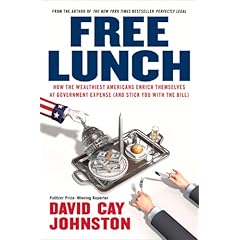
David Cay Johnston, took a look at income patterns in the U.S. over the past few decades in his new book, “Free Lunch: How the Wealthiest Americans Enrich Themselves at Government Expense (and Stick You With the Bill).”


From 1980 to 2005 the national economy, adjusted for inflation, more than doubled. (Because of population growth, the actual increase per capita was about 66 percent.) But the average income for the vast majority of Americans actually declined during that period. The standard of living for the average family has improved not because incomes have grown, but because women have gone into the workplace in droves.

90 percent of the population missed out on the income gains during the sacredly touted 'economic expansion' of the Reagan-Bush Republican Eras

The peak income year for the bottom 90 percent of Americans was way back in 1973 — when the average income per taxpayer (adjusted for inflation) was $33,001. That is nearly $4,000 higher than the average in 2005.


It’s incredible but true: 90 percent of the population missed out on the income gains during that long period.

Mr. Johnston does not mince words: “The pattern here is clear. The rich are getting fabulously richer, the vast majority are somewhat worse off, and the bottom half — for all practical purposes, the poor — are being savaged by our current economic policies.”


.....

For ordinary Americans, jobs are the be-all and end-all. And an America awash in new jobs will require a political environment that respects and rewards work and aggressively pursues creative policies designed to radically expand employment.


Kevin Phillips, a former supporter of Reagan and his policies, also radically changed his mind as he has documented the rich getting far richer much faster while working families have drastically lost ground under the republicans since 1980.

As Rich and others note, the Republican candidates are looking longingly into the past -- almost 30 years past! But the economic reality of these past 30 years will likely continue to show that invoking Reagan to democrats and working Americans is rocky territory fraught with danger and filled with fairy-tales and lies.

Even our British allies are giddy with anticipation of an election change: Just one more year! Good riddance to George W Bush.

Rich's column is already available here; Dowd's is here.


Technorati Tags:
, , , ,


Labels: , , , , , , , , , ,

Monday, August 13, 2007

American Denial: USA Healthcare System is NOT World's Best

A continuing series about: Primary Reasons Americans Should Reject Bush, Cheney, Rove & the Republicans Now and in 2008


World’s Best Medical Care?


NYTimes Editorial

August 12, 2007


Many Americans are under the delusion that we have “the best health care system in the world,” as President Bush sees it, or provide the “best medical care in the world,” as Rudolph Giuliani declared last week. That may be true at many top medical centers. But the disturbing truth is that this country lags well behind other advanced nations in delivering timely and effective care.


Michael Moore struck a nerve in his new documentary, “Sicko,” when he extolled the virtues of the government-run health care systems in France, England, Canada and even Cuba while deploring the failures of the largely private insurance system in this country. There is no question that Mr. Moore overstated his case by making foreign systems look almost flawless. But there is a growing body of evidence that, by an array of pertinent yardsticks, the United States is a laggard not a leader in providing good medical care.


Seven years ago, the World Health Organization made the first major effort to rank the health systems of 191 nations. France and Italy took the top two spots; the United States was a dismal 37th. More recently, the highly regarded Commonwealth Fund has pioneered in comparing the United States with other advanced nations through surveys of patients and doctors and analysis of other data. Its latest report, issued in May, ranked the United States last or next-to-last compared with five other nations — Australia, Canada, Germany, New Zealand and the United Kingdom — on most measures of performance, including quality of care and access to it. Other comparative studies also put the United States in a relatively bad light.


Insurance coverage. All other major industrialized nations provide universal health coverage, and most of them have comprehensive benefit packages with no cost-sharing by the patients. The United States, to its shame, has some 45 million people without health insurance and many more millions who have poor coverage. Although the president has blithely said that these people can always get treatment in an emergency room, many studies have shown that people without insurance postpone treatment until a minor illness becomes worse, harming their own health and imposing greater costs.


Access. Citizens abroad often face long waits before they can get to see a specialist or undergo elective surgery. Americans typically get prompter attention, although Germany does better. The real barriers here are the costs facing low-income people without insurance or with skimpy coverage. But even Americans with above-average incomes find it more difficult than their counterparts abroad to get care on nights or weekends without going to an emergency room, and many report having to wait six days or more for an appointment with their own doctors.


Fairness. The United States ranks dead last on almost all measures of equity because we have the greatest disparity in the quality of care given to richer and poorer citizens. Americans with below-average incomes are much less likely than their counterparts in other industrialized nations to see a doctor when sick, to fill prescriptions or to get needed tests and follow-up care.


Healthy lives. We have known for years that America has a high infant mortality rate, so it is no surprise that we rank last among 23 nations by that yardstick. But the problem is much broader. We rank near the bottom in healthy life expectancy at age 60, and 15th among 19 countries in deaths from a wide range of illnesses that would not have been fatal if treated with timely and effective care. The good news is that we have done a better job than other industrialized nations in reducing smoking. The bad news is that our obesity epidemic is the worst in the world.


Quality. In a comparison with five other countries, the Commonwealth Fund ranked the United States first in providing the “right care” for a given condition as defined by standard clinical guidelines and gave it especially high marks for preventive care, like Pap smears and mammograms to detect early-stage cancers, and blood tests and cholesterol checks for hypertensive patients. But we scored poorly in coordinating the care of chronically ill patients, in protecting the safety of patients, and in meeting their needs and preferences, which drove our overall quality rating down to last place. American doctors and hospitals kill patients through surgical and medical mistakes more often than their counterparts in other industrialized nations.


Life and death. In a comparison of five countries, the United States had the best survival rate for breast cancer, second best for cervical cancer and childhood leukemia, worst for kidney transplants, and almost-worst for liver transplants and colorectal cancer. In an eight-country comparison, the United States ranked last in years of potential life lost to circulatory diseases, respiratory diseases and diabetes and had the second highest death rate from bronchitis, asthma and emphysema. Although several factors can affect these results, it seems likely that the quality of care delivered was a significant contributor.


Patient satisfaction. Despite the declarations of their political leaders, many Americans hold surprisingly negative views of their health care system. Polls in Europe and North America seven to nine years ago found that only 40 percent of Americans were satisfied with the nation’s health care system, placing us 14th out of 17 countries. In recent Commonwealth Fund surveys of five countries, American attitudes stand out as the most negative, with a third of the adults surveyed calling for rebuilding the entire system, compared with only 13 percent who feel that way in Britain and 14 percent in Canada.


That may be because Americans face higher out-of-pocket costs than citizens elsewhere, are less apt to have a long-term doctor, less able to see a doctor on the same day when sick, and less apt to get their questions answered or receive clear instructions from a doctor. On the other hand, Gallup polls in recent years have shown that three-quarters of the respondents in the United States, in Canada and in Britain rate their personal care as excellent or good, so it could be hard to motivate these people for the wholesale change sought by the disaffected.


Use of information technology. Shockingly, despite our vaunted prowess in computers, software and the Internet, much of our health care system is still operating in the dark ages of paper records and handwritten scrawls. American primary care doctors lag years behind doctors in other advanced nations in adopting electronic medical records or prescribing medications electronically. This makes it harder to coordinate care, spot errors and adhere to standard clinical guidelines.


Top-of-the-line care. Despite our poor showing in many international comparisons, it is doubtful that many Americans, faced with a life-threatening illness, would rather be treated elsewhere. We tend to think that our very best medical centers are the best in the world. But whether this is a realistic assessment or merely a cultural preference for the home team is difficult to say. Only when better measures of clinical excellence are developed will discerning medical shoppers know for sure who is the best of the best.


•


With health care emerging as a major issue in the presidential campaign and in Congress, it will be important to get beyond empty boasts that this country has “the best health care system in the world” and turn instead to fixing its very real defects. The main goal should be to reduce the huge number of uninsured, who are a major reason for our poor standing globally. But there is also plenty of room to improve our coordination of care, our use of computerized records, communications between doctors and patients, and dozens of other factors that impair the quality of care. The world’s most powerful economy should be able to provide a health care system that really is the best.


Source: NY Times Editorial


Technorati Tags:
, , , ,


Labels: , , , , , , , , , ,

Sunday, July 08, 2007

New York Times Editorial: End the War Now, Leave Iraq ASAP

This Editorial calls for a reasoned strategy and draw-down, not immediate withdrawal leaving an already bloody and chaotic situation in even worse chaos. But it is past time to stop the charade, lies and demagoguery. Past Time to SHOUT Truth to Power!

"
Bush and Cheney have used demagoguery and fear to quell Americans’ demands for an end to this war. They say withdrawing will create bloodshed and chaos and encourage terrorists. Actually, all of that has already happened — the result of this unnecessary invasion and the incompetent management of this war.

This country faces a choice. We can go on allowing Mr. Bush to drag out this war without end or purpose. Or we can insist that American troops are withdrawn as quickly and safely as we can manage — with as much effort as possible to stop the chaos from spreading.
"


July 8, 2007
Editorial

The Road Home


It is time for the United States to leave Iraq, without any more delay than the Pentagon needs to organize an orderly exit.

•

Like many Americans, we have put off that conclusion, waiting for a sign that President Bush was seriously trying to dig the United States out of the disaster he created by invading Iraq without sufficient cause, in the face of global opposition, and without a plan to stabilize the country afterward.

At first, we believed that after destroying Iraq’s government, army, police and economic structures, the United States was obliged to try to accomplish some of the goals Mr. Bush claimed to be pursuing, chiefly building a stable, unified Iraq. When it became clear that the president had neither the vision nor the means to do that, we argued against setting a withdrawal date while there was still some chance to mitigate the chaos that would most likely follow.

While Mr. Bush scorns deadlines, he kept promising breakthroughs — after elections, after a constitution, after sending in thousands more troops. But those milestones came and went without any progress toward a stable, democratic Iraq or a path for withdrawal. It is frighteningly clear that Mr. Bush’s plan is to stay the course as long as he is president and dump the mess on his successor. Whatever his cause was, it is lost.

The political leaders Washington has backed are incapable of putting national interests ahead of sectarian score settling. The security forces Washington has trained behave more like partisan militias. Additional military forces poured into the Baghdad region have failed to change anything.

Continuing to sacrifice the lives and limbs of American soldiers is wrong. The war is sapping the strength of the nation’s alliances and its military forces. It is a dangerous diversion from the life-and-death struggle against terrorists. It is an increasing burden on American taxpayers, and it is a betrayal of a world that needs the wise application of American power and principles.

A majority of Americans reached these conclusions months ago. Even in politically polarized Washington, positions on the war no longer divide entirely on party lines. When Congress returns this week, extricating American troops from the war should be at the top of its agenda.

That conversation must be candid and focused. Americans must be clear that Iraq, and the region around it, could be even bloodier and more chaotic after Americans leave. There could be reprisals against those who worked with American forces, further ethnic cleansing, even genocide. Potentially destabilizing refugee flows could hit Jordan and Syria. Iran and Turkey could be tempted to make power grabs. Perhaps most important, the invasion has created a new stronghold from which terrorist activity could proliferate.

The administration, the Democratic-controlled Congress, the United Nations and America’s allies must try to mitigate those outcomes — and they may fail. But Americans must be equally honest about the fact that keeping troops in Iraq will only make things worse. The nation needs a serious discussion, now, about how to accomplish a withdrawal and meet some of the big challenges that will arise.

The Mechanics of Withdrawal

The United States has about 160,000 troops and millions of tons of military gear inside Iraq. Getting that force out safely will be a formidable challenge. The main road south to Kuwait is notoriously vulnerable to roadside bomb attacks. Soldiers, weapons and vehicles will need to be deployed to secure bases while airlift and sealift operations are organized. Withdrawal routes will have to be guarded. The exit must be everything the invasion was not: based on reality and backed by adequate resources.

The United States should explore using Kurdish territory in the north of Iraq as a secure staging area. Being able to use bases and ports in Turkey would also make withdrawal faster and safer. Turkey has been an inconsistent ally in this war, but like other nations, it should realize that shouldering part of the burden of the aftermath is in its own interest.

Accomplishing all of this in less than six months is probably unrealistic. The political decision should be made, and the target date set, now.

The Fight Against Terrorists

Despite President Bush’s repeated claims, Al Qaeda had no significant foothold in Iraq before the invasion, which gave it new base camps, new recruits and new prestige.

This war diverted Pentagon resources from Afghanistan, where the military had a real chance to hunt down Al Qaeda’s leaders. It alienated essential allies in the war against terrorism. It drained the strength and readiness of American troops.

And it created a new front where the United States will have to continue to battle terrorist forces and enlist local allies who reject the idea of an Iraq hijacked by international terrorists. The military will need resources and bases to stanch this self- inflicted wound for the foreseeable future.

The Question of Bases

The United States could strike an agreement with the Kurds to create those bases in northeastern Iraq. Or, the Pentagon could use its bases in countries like Kuwait and Qatar, and its large naval presence in the Persian Gulf, as staging points.

There are arguments for, and against, both options. Leaving troops in Iraq might make it too easy — and too tempting — to get drawn back into the civil war and confirm suspicions that Washington’s real goal was to secure permanent bases in Iraq. Mounting attacks from other countries could endanger those nations’ governments.

The White House should make this choice after consultation with Congress and the other countries in the region, whose opinions the Bush administration has essentially ignored. The bottom line: the Pentagon needs enough force to stage effective raids and airstrikes against terrorist forces in Iraq, but not enough to resume large-scale combat.

The Civil War

One of Mr. Bush’s arguments against withdrawal is that it would lead to civil war. That war is raging, right now, and it may take years to burn out. Iraq may fragment into separate Kurdish, Sunni and Shiite republics, and American troops are not going to stop that from happening.

It is possible, we suppose, that announcing a firm withdrawal date might finally focus Iraq’s political leaders and neighboring governments on reality. Ideally, it could spur Iraqi politicians to take the steps toward national reconciliation that they have endlessly discussed but refused to act on.

But it is foolish to count on that, as some Democratic proponents of withdrawal have done. The administration should use whatever leverage it gains from withdrawing to press its allies and Iraq’s neighbors to help achieve a negotiated solution.

Iraq’s leaders — knowing that they can no longer rely on the Americans to guarantee their survival — might be more open to compromise, perhaps to a Bosnian-style partition, with economic resources fairly shared but with millions of Iraqis forced to relocate. That would be better than the slow-motion ethnic and religious cleansing that has contributed to driving one in seven Iraqis from their homes.

The United States military cannot solve the problem. Congress and the White House must lead an international attempt at a negotiated outcome. To start, Washington must turn to the United Nations, which Mr. Bush spurned and ridiculed as a preface to war.

The Human Crisis

There are already nearly two million Iraqi refugees, mostly in Syria and Jordan, and nearly two million more Iraqis who have been displaced within their country. Without the active cooperation of all six countries bordering Iraq — Turkey, Iran, Kuwait, Saudi Arabia, Jordan and Syria — and the help of other nations, this disaster could get worse. Beyond the suffering, massive flows of refugees — some with ethnic and political resentments — could spread Iraq’s conflict far beyond Iraq’s borders.

Kuwait and Saudi Arabia must share the burden of hosting refugees. Jordan and Syria, now nearly overwhelmed with refugees, need more international help. That, of course, means money. The nations of Europe and Asia have a stake and should contribute. The United States will have to pay a large share of the costs, but should also lead international efforts, perhaps a donors’ conference, to raise money for the refugee crisis.

Washington also has to mend fences with allies. There are new governments in Britain, France and Germany that did not participate in the fight over starting this war and are eager to get beyond it. But that will still require a measure of humility and a commitment to multilateral action that this administration has never shown. And, however angry they were with President Bush for creating this mess, those nations should see that they cannot walk away from the consequences. To put it baldly, terrorism and oil make it impossible to ignore.

The United States has the greatest responsibilities, including the admission of many more refugees for permanent resettlement. The most compelling obligation is to the tens of thousands of Iraqis of courage and good will — translators, embassy employees, reconstruction workers — whose lives will be in danger because they believed the promises and cooperated with the Americans.

The Neighbors

One of the trickiest tasks will be avoiding excessive meddling in Iraq by its neighbors — America’s friends as well as its adversaries.

Just as Iran should come under international pressure to allow Shiites in southern Iraq to develop their own independent future, Washington must help persuade Sunni powers like Syria not to intervene on behalf of Sunni Iraqis. Turkey must be kept from sending troops into Kurdish territories.

For this effort to have any remote chance, Mr. Bush must drop his resistance to talking with both Iran and Syria. Britain, France, Russia, China and other nations with influence have a responsibility to help. Civil war in Iraq is a threat to everyone, especially if it spills across Iraq’s borders.

•

President Bush and Vice President Dick Cheney have used demagoguery and fear to quell Americans’ demands for an end to this war. They say withdrawing will create bloodshed and chaos and encourage terrorists. Actually, all of that has already happened — the result of this unnecessary invasion and the incompetent management of this war.

This country faces a choice. We can go on allowing Mr. Bush to drag out this war without end or purpose. Or we can insist that American troops are withdrawn as quickly and safely as we can manage — with as much effort as possible to stop the chaos from spreading.

Labels: , , , , , , , , , , , , , , , ,

Friday, March 23, 2007

Amerika The Fascist Police State: How I learned to stop resenting the Patriot Act and started learning to love kissing the ass of the fascist in chief


First, the prophecy of Ben Franklin (paraphrased):

Those who trade freedom for security deserve neither.

After reading the anonymous editorial/column below, a streaming of consciousness emerged starting with a famous, controversial (naive) Beatles song, but the similarities end there:


Back in the USSR — Amerika.
Big Brother is here and
His names are George Bush, Dick Cheney, Karl Rove, Alberto Gonzales, Robert Mueller, Tom Delay, the FBI, law enforcement, credit card companies, corporate america, republican wingnuts, dittoheads, moral majority, evangelical christian, theocratic fervor, the health care system, insurance companies ....
and you Amerikkkan Lemmings stand by
sucking your thumbs and
Voting for your Amerikkkan Idols and
Praying to your imaginary fairy tale fathers
with flowing beards sitting on clouds.
If this does not scare the bejesus out of you and
tell you
how far down the fascist rabbit hole we have fallen ... then
you do not deserve democracy Amerika the lemmingful.
America that used to care about ideals and democracy and justice --
now Amerika the pathetic joke rapidly becoming a third world dictatorship.


One of the scariest editorials I have ever read. The implications are enormous.
Can you say AMERIKA the FASCIST POLICE STATE?


My National Security Letter Gag Order
I resent being conscripted as a secret informer for the government.

Friday, March 23, 2007

By Anonymous

The Justice Department's inspector general revealed on March 9 that the FBI has been systematically abusing one of the most controversial provisions of the USA Patriot Act: the expanded power to issue "national security letters." It no doubt surprised most Americans to learn that between 2003 and 2005 the FBI issued more than 140,000 specific demands under this provision -- demands issued without a showing of probable cause or prior judicial approval -- to obtain potentially sensitive information about U.S. citizens and residents. It did not, however, come as any surprise to me.

Three years ago, I received a national security letter (NSL) in my capacity as the president of a small Internet access and consulting business. The letter ordered me to provide sensitive information about one of my clients. There was no indication that a judge had reviewed or approved the letter, and it turned out that none had. The letter came with a gag provision that prohibited me from telling anyone, including my client, that the FBI was seeking this information. Based on the context of the demand -- a context that the FBI still won't let me discuss publicly -- I suspected that the FBI was abusing its power and that the letter sought information to which the FBI was not entitled.

Rather than turn over the information, I contacted lawyers at the American Civil Liberties Union, and in April 2004 I filed a lawsuit challenging the constitutionality of the NSL power. I never released the information the FBI sought, and last November the FBI decided that it no longer needs the information anyway. But the FBI still hasn't abandoned the gag order that prevents me from disclosing my experience and concerns with the law or the national security letter that was served on my company. In fact, the government will return to court in the next few weeks to defend the gag orders that are imposed on recipients of these letters.

Living under the gag order has been stressful and surreal. Under the threat of criminal prosecution, I must hide all aspects of my involvement in the case -- including the mere fact that I received an NSL -- from my colleagues, my family and my friends. When I meet with my attorneys I cannot tell my girlfriend where I am going or where I have been. I hide any papers related to the case in a place where she will not look. When clients and friends ask me whether I am the one challenging the constitutionality of the NSL statute, I have no choice but to look them in the eye and lie.

I resent being conscripted as a secret informer for the government and being made to mislead those who are close to me, especially because I have doubts about the legitimacy of the underlying investigation.

The inspector general's report makes clear that NSL gag orders have had even more pernicious effects. Without the gag orders issued on recipients of the letters, it is doubtful that the FBI would have been able to abuse the NSL power the way that it did. Some recipients would have spoken out about perceived abuses, and the FBI's actions would have been subject to some degree of public scrutiny. To be sure, not all recipients would have spoken out; the inspector general's report suggests that large telecom companies have been all too willing to share sensitive data with the agency -- in at least one case, a telecom company gave the FBI even more information than it asked for. But some recipients would have called attention to abuses, and some abuse would have been deterred.

I found it particularly difficult to be silent about my concerns while Congress was debating the reauthorization of the Patriot Act in 2005 and early 2006. If I hadn't been under a gag order, I would have contacted members of Congress to discuss my experiences and to advocate changes in the law. The inspector general's report confirms that Congress lacked a complete picture of the problem during a critical time: Even though the NSL statute requires the director of the FBI to fully inform members of the House and Senate about all requests issued under the statute, the FBI significantly underrepresented the number of NSL requests in 2003, 2004 and 2005, according to the report.

I recognize that there may sometimes be a need for secrecy in certain national security investigations. But I've now been under a broad gag order for three years, and other NSL recipients have been silenced for even longer. At some point -- a point we passed long ago -- the secrecy itself becomes a threat to our democracy. In the wake of the recent revelations, I believe more strongly than ever that the secrecy surrounding the government's use of the national security letters power is unwarranted and dangerous. I hope that Congress will at last recognize the same thing.


Footnote by the WP:
It is the policy of The Washington Post not to publish anonymous pieces. In this case, an exception has been made because the author -- who would have preferred to be named -- is legally prohibited from disclosing his or her identity in connection with receipt of a national security letter. The Post confirmed the legitimacy of this submission by verifying it with the author's attorney and by reviewing publicly available court documents.


From the WashingtonPost.com

PS: Doesn't the guy on the left side of the movie poster eerily remind you of someone who currently occupies an ENORMOUSLY influential position in the white house -- in fact, maybe it looks like two of them, one elected, one not. Both dangerous.

Labels: , , , , , , , , , , , , , ,

Progressive Women Bloggers Ring
Power By Ringsurf